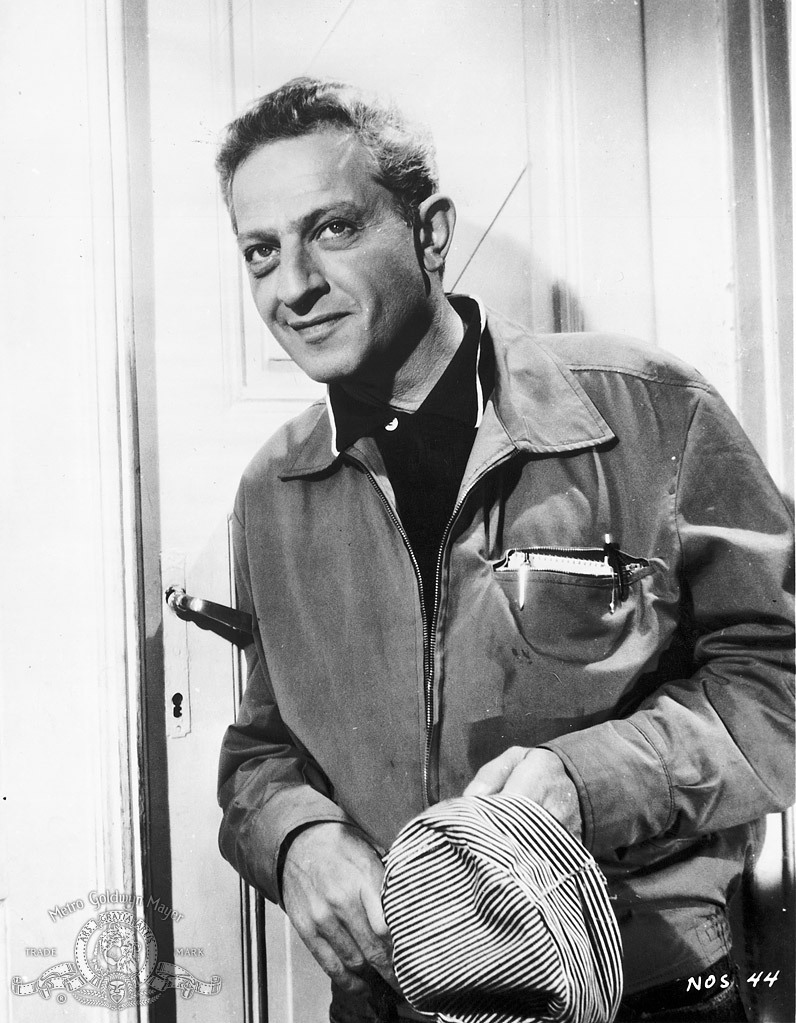
Jules Dassin was an Academy Award-nominated director, screenwriter and actor best known for his films
Rififi (1955),
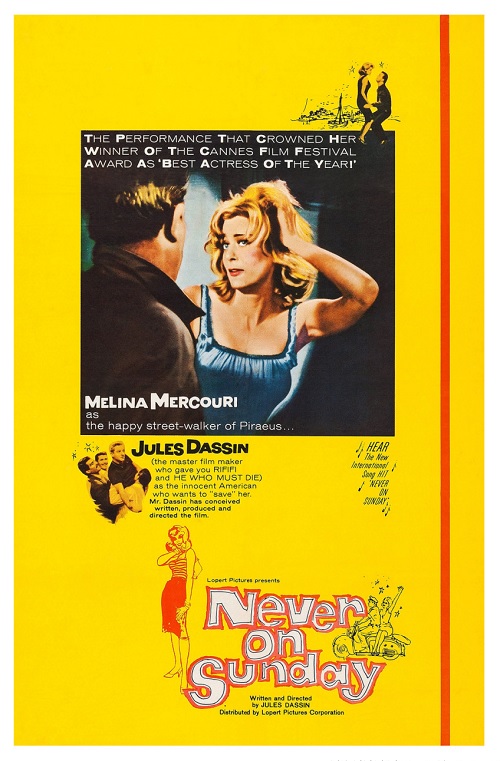
Never on Sunday (1960), and
Topkapi (1964).
He was born Julius Samuel Dassin on 18 December 1911, in Middletown, Connecticut, USA. He was one of eight children of Russian-Jewish immigrants, Samuel Dassin and Berthe Vogel. Young Dassin grew up in Harlem, and he attended Morris High School in the Bronx, graduating in 1929. After taking acting classes in Europe, he returned to New York. In 1934, he became and actor with the ARTEF Players (Arbeter Teater Farband), and was a member of the troupe until 1939. Dassin played character roles in Yiddish, mainly in the plays by
Sholom Aleichem. But upon discovering "that an actor I was not," he switched to directing and writing. At that time, he joined the Communist Party of the United States, but left the party in 1939, he said, disillusioned after the Soviet Union signed a pact with
Adolf Hitler.
Dassin came to Hollywood in 1940, and was an apprentice to directors
Alfred Hitchcock and
Garson Kanin. In 1941, he made his directorial debut at MGM with adaptation of a story by
Edgar Allan Poe. Dassin's best directorial works for Hollywood include such criminal dramas as
Brute Force (1947) starring
Burt Lancaster;
The Naked City (1948), one of the first police dramas shot on the streets of New York; and
Night and the City (1950) starring
Richard Widmark as a hustler in London who is caught up in his own schemes. While he was assigned by producer
Darryl F. Zanuck to make the film, Dassin was accused of affiliation with the Communist Party in his past. Zanuck advised Dassin to "shoot the expensive scenes first, to hook the studio" so the film was finished and released in 1951. Dassin was reported to HUAC in a 1951 testimony by directors
Edward Dmytryk and
Frank Tuttle. That was enough to sink his career in Hollywood. Dassin was subpoenaed by HUAC in 1952 and eventually became blacklisted after refusing to testify before the House Un-American Activities Committee.
He left the United States for France in 1953 and struggled during his first years in Paris. He was not fluent in French, and his connections were limited. However, Dassin's low-budget film,
Rififi (1955), famous for its long heist sequence that was free of dialog, won him the Best Director Award at the 1955 Cannes Film Festival. There, he met the Greek actress
Melina Mercouri. Later, Dassin co-starred opposite Mercouri in his film
Never on Sunday (1960), which won the Best Film Award at Cannes in 1960. At that time, the anti-Communist witch hunt in America was fading, and Dassin was accepted again. He received two Academy Award-nominations for directing and screen-writing for
Topkapi (1964), starring Mercouri,
Maximilian Schell, and
Peter Ustinov. Dassin also served as member of jury at the Cannes and several other international film festivals.
Jules Dassin was married twice. He had three children with his first wife, violinist Beatrice Launer. His son,
Joe Dassin, was a popular French singer in the 1960s and '70s, with such hits as "Bip Bip," "L'Eté Indien" and "Aux Champs-Èlysées." In 1966, Jules Dassin married Mercouri, an ardent anti-fascist who lost her Greek citizenship for opposing the junta, and the couple was living in Manhattan, remaining very active in their efforts to restore democracy in Greece during the dictatorship of the Colonels. After 1974, the couple returned to Greece, Mercouri became a member of the Greek Parliament, and Culture Minister of Greece. While living in Athens, Dassin was active in the effort to bring the 2500-year-old Elgin marbles of the Parthenon back to Athens from their current location at the British Museum in London. In this and other humanitarian causes, Dassin followed the last will of his late wife.
Jules Dassin died of complications caused by a flu, on April 1, 2008, at age 96, at Hygeia Hospital in Athens, Greece. He is survived by two daughters and grandchildren.
 Obsession(1980)
 A Dream of Passion(1978)
 The Rehearsal(1974)
 Promise at Dawn(1970)
 Uptight(1968)
 10:30 P.M. Summer(1966)
 Topkapi(1964)as Turkish Cop
 Phaedra(1962)as Christos
 Never on Sunday(1960)as Homer Thrace
 Rififi(1955)as César le milanais
 Survival 1967(1968)
 He Who Must Die(1957)
 Night and the City(1992)
 The Price of Love(1984)
 Otan giortazoun oi theoi(2007)as Self
 Mikis Theodorakis: Ta proima hronia 1950-1970(2005)as Self
 The Long Haul of A.I. Bezzerides(2005)as Self
 Filmmakers in Action(2005)as Self
 Buzz(2005)
 Compression(1995)as Self
 Elective Vicissitudes: The Radical Exiles of Jules Dassin(2023)as Self
 Film Önü / Arkasi(2019)as Self
 Lundi en histoires(2014)as Self
 Vivement dimanche(1998)as Self


