Nikolai (Mykola) Gogol was a Russian humorist, dramatist, and novelist of Ukrainian origin.
His ancestors were bearing the name of Gogol-Janovsky and claimed
belonging to the upper class Polish Szlachta. Gogol's father, a
Ukrainian writer living on his old family estate, had five other
children. He died when the Gogol was 15. Young Gogol was fond of the
drama class at his high school in Nezhin, Ukraine. He was strongly
influenced by his religious mother, as well as by the enchanting beauty
of the Ukrainian folklore. He also called himself a "free Cossac".
At age 18 Gogol moved to St. Petersburg, became a student, and later a
professor of history at the St. Petersburg University. His short
stories, set in St. Petersburg, became a success. His play "Revizor"
(1836, The Inspector General) had its premiere in St. Petersburg
attended by the Tzar Nickolai I. But it also made him many powerful
enemies who hated his satire on the corrupt Russian society. It was his
friend
Aleksandr Pushkin who suggested to him the subject for "Revizor". Pushkin
also suggested the main idea of "The Dead Souls" (1842), a bitter
satirical story of a crook, who was buying the names of dead surfs from
various greedy landlords, for a tax-evasion scheme. In his other famous
story "Shinel" (1842, The Overcoat) a poor clerk is intimidated both by
thieves and by the government. Gogol's discontent against the slavery
and social injustices in Russia caused him trouble. He escaped to
Europe for 12 years, returning to Russia briefly to publish the 1st
part of "The Dead Souls".
His religious beliefs were used by the State-controlled Orthodox Church
to place guilt on him and to cause interruption of his literary work.
In 1848 he made a pilgrimage to Jerusalem. After his return to Russia,
he settled in Moscow, where he fell under the control of the fanatical
Orthodox priest, Konstantinovskii, who demanded that Gogol quit writing
and destroy the manuscript of the 2nd part of "The Dead Souls". Torn by
his inner conflict with guilt and being under the pressure from the
fanatical priest, Gogol burned his manuscript. He died nine days later
in pain without having any food during his last days. In the 1931
excavation of his tomb, his body was found lying face down, which
caused suspicion that Gogol was buried alive.
His style involves the elements of the fantastic and grotesque, with
the taste for the macabre and absurd, following the tradition of
E.T.A. Hoffmann.
Fyodor Dostoevsky proclaimed, "We all came out from under his Overcoat",
referring to Gogol's influence on Russian writers. Sometimes compared
with
Franz Kafka, Gogol had such followers, as
Yevgeni Zamyatin,
Vladimir Nabokov, and
Mikhail A. Bulgakov.

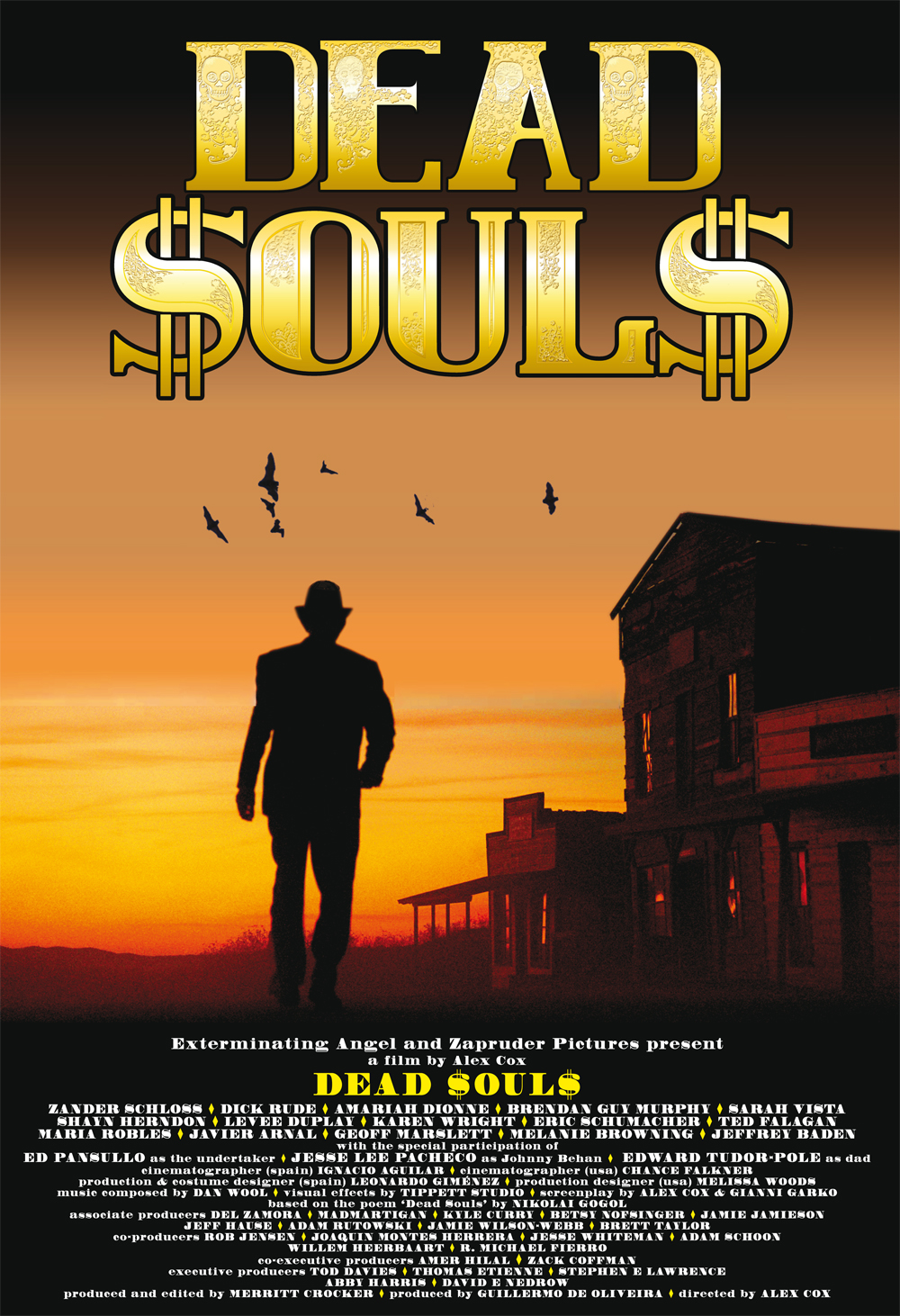 Dead Souls(2025)
 Selecciones de Cineficción Radio(2024)
 Noch pered Rozhdestvom(2024)
 The Overcoat(2021)
 Diaries of the traveler(2024)
 Novodevichy cemetery. Summer(2020)
 St. Petersburg. The melody of the northern capital(2020)
 Novodevichy cemetery(2019)
 TeleviZion(2018)
 Kentler Ve Gölgeler(2010)as Self - Subject