Being one of numerous important comedians during the silent era whose
popularity has turned into almost complete obscurity, Lloyd Hamilton
has nevertheless earned a reputation as an original talent among film
historians and enthusiasts. Born into a conservative middle-class
family in California, presumably in 1891, Hamilton began his career as
an extra in theatre-productions. He entered films at an early age,
although the exact year remains hard to specify; he claimed to have
appeared in his first films at Lubin Company in 1914, but he can be
glimpsed in a few surviving Frontier-comedies from the year before.
However, it is correct that it was in the year of 1914 that he first
gained success, when he teamed up with Bud Duncan in Kalem's 'Ham and
Bud'-series, being one of the very first permanent comedy teams
produced in the movies. The series turned out moderately popular and
ran for three years, although it can be hard to understand this success
for modern viewers; by common agreement, the 'Ham and Bud'-films have
not aged well and remain of interest mostly due to the limited insight
into Hamilton's maturity as a performer that they provide.
Hamilton left Kalem for Fox in late 1917, where he appeared on his own
under the direction of Henry Lehrman and Jack White. Along with White
and another director who would later reach fame as a performer in his
own right, Charley Chase, Hamilton established 'Mermaid Comedies' in
1920, a production unit exclusively dedicated to comedy shorts. He
appeared in a number of films over the next few years; sadly, only a
few of these are known to exist today, but comedies such as "Moonshine"
and "The Simp" (both 1920) confirm Hamilton's progression as a
performer during this time. Indeed, by 1922 he was hailed in the press
as a "great comedy coup" and audiences had already taken notice of him.
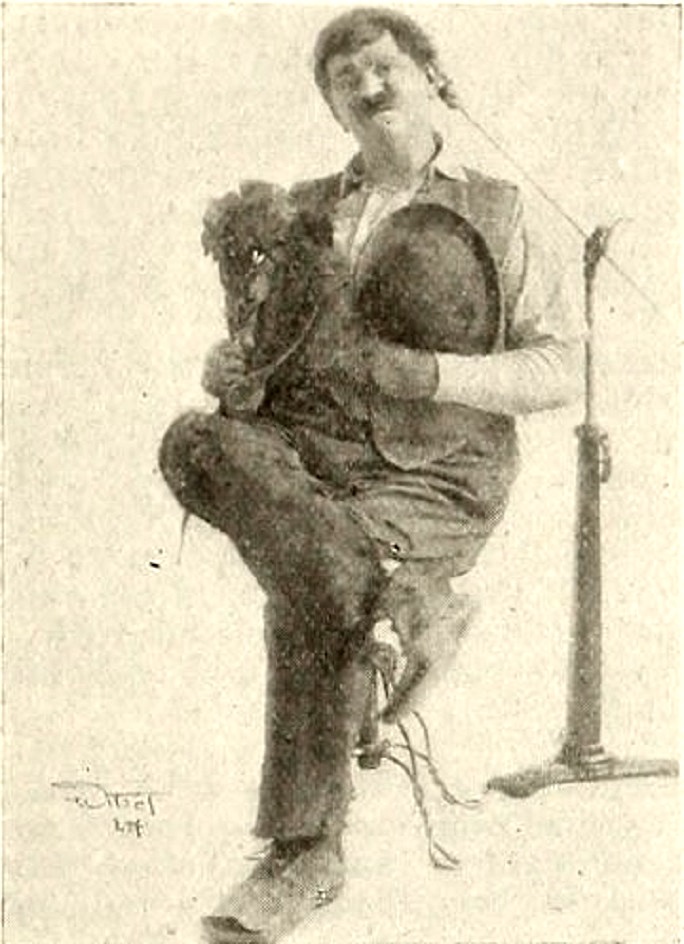
Hamilton's screen personality was something of its own, inheriting very
few traits of the other major comedians of the time; tubby and
baby-faced though he was, his character was a childish man of personal
contrasts: he possessed a touch of bewilderment, irresponsibility,
incredible self-assurance and frustration that gave him a partly tragic
complexion, which in return probably made his comedy more appealing to
adults than children.
By the mid-1920s, Hamilton's popularity had grown such a degree that he
considered it appropriate to establish his own production company. It
was about this time that he starred in his first feature-length film,
"The Darker Self," a film which does not only seem rather tasteless
today due to the use of racial stereotypes, but which in fact was a
disaster also when originally released and Hamilton's reputation
suffered a blow because of it. He nevertheless produced many fine short
comedies throughout the decade, such as "Move Along" (1926), "Nobody's
Business" (1926) and "Somebody's Fault" (1927), most of which were
directed by Norman Taurog. While it may be argued that some of the
films suffer from lack of continuity, they often provide many clever
visual gags and camera-tricks which still make them pleasant to watch;
in fact, in one respect absence of continuity suits Hamilton's
character well, as his movies are not so often based upon a particular
story as of him being constantly haunted by bad luck, with one bad
situation leading up to an even worse situation.
Despite being so very amusing on-screen, Hamilton led a troublesome
private life. He was a hard drinker, which severely affected his family
life. His first marriage was to actress Ethel Lloyd, five years his
senior, which took place at an early point of his movie career and
lasted just a few years; they were separated by 1923, and their split
caused a two-year long court battle. He married a second time in 1927
to Irene Dalton, who had appeared in some of his films. Dalton accused
her husband of being violent when drunk, and the couple divorced after
a year. (None of the marriages produced any children.) In the midst of
these personal difficulties, Hamilton was suddenly banned from the
screen after a boxer was murdered in a street-fight in which he was
involved; the comedian was not a suspect, but the tolerance of scandals
was minimal in Hollywood at this time and he remained unemployed for
more than a year. He did a comeback in a series of two-reeler's for
Mack Sennett at Educational Films in 1929, this time in sound pictures,
which had just done its lasting entrance in the medium. Lloyd had a
good voice which suited his character perfectly, but by this time his
troubled life-style had begun to get the better of him. After the
contract with Sennett expired, it was rumored that he would begin a new
series of two-reeler's for Hal Roach, but being informed of Hamilton's
alcoholism, Roach refused to hire him. He died unemployed and ill in
1935, aged 43.
During his brief period as a star, Charlie Chaplin is reported to have
remarked that Lloyd Hamilton "is the one actor of whom I am jealous,"
and Charley Chase confessed that whenever he had difficulties in doing
a scene, he'd always ask himself, "How would Lloyd have done it?"
Buster Keaton also expressed great fondness of his work, stating in a
late interview that Hamilton was "one of the funniest men in pictures."
Critic and playwright Walter Kerr, considered by many the most
insightful authority on silent comedy, discusses his work with great
respect and admiration in his 1975-book "The Silent Clowns." However,
despite all acclaim, Lloyd Hamilton is exceedingly seldom given a
mention today even among silent comedy fans. One significant reason to
this is his sad lack of surviving output; most of his negatives were
destroyed in a laboratory fire at Universal shortly after his death.
Happily, a fine collection of his work is now available on DVD through
silent comedy specialists "Looser Than Loose."
 The Optimist(1923)
 Ham the Diver(1916)
 Minnie the Tiger(1915)
 Pop's Pal(1933)as Mr. Pearson
 Too Many Highballs(1933)as Harold Hobbs
 Listen Children(1928)
 A Home-Made Man(1928)
 Show of Shows(1929)
 Star Night at the Cocoanut Grove(1934)as Self
 Hollywood on Parade No. B-5(1933)as Self
 The Voice of Hollywood No. 12(1930)as Self - Guest Host
 The Voice of Hollywood No. 1(1929)as Self - Guest Host
 Life in Hollywood No. 2(1927)as Self
 The Mack Sennett Collection: Volume One(2014)
 The Forgotten Films of Roscoe Fatty Arbuckle(2005)
 Slaphappy(2001)as Self (2001)
 Horen Zien Zwijgen(1976)as Various
 Hollywood and the Stars(1963)as Self


