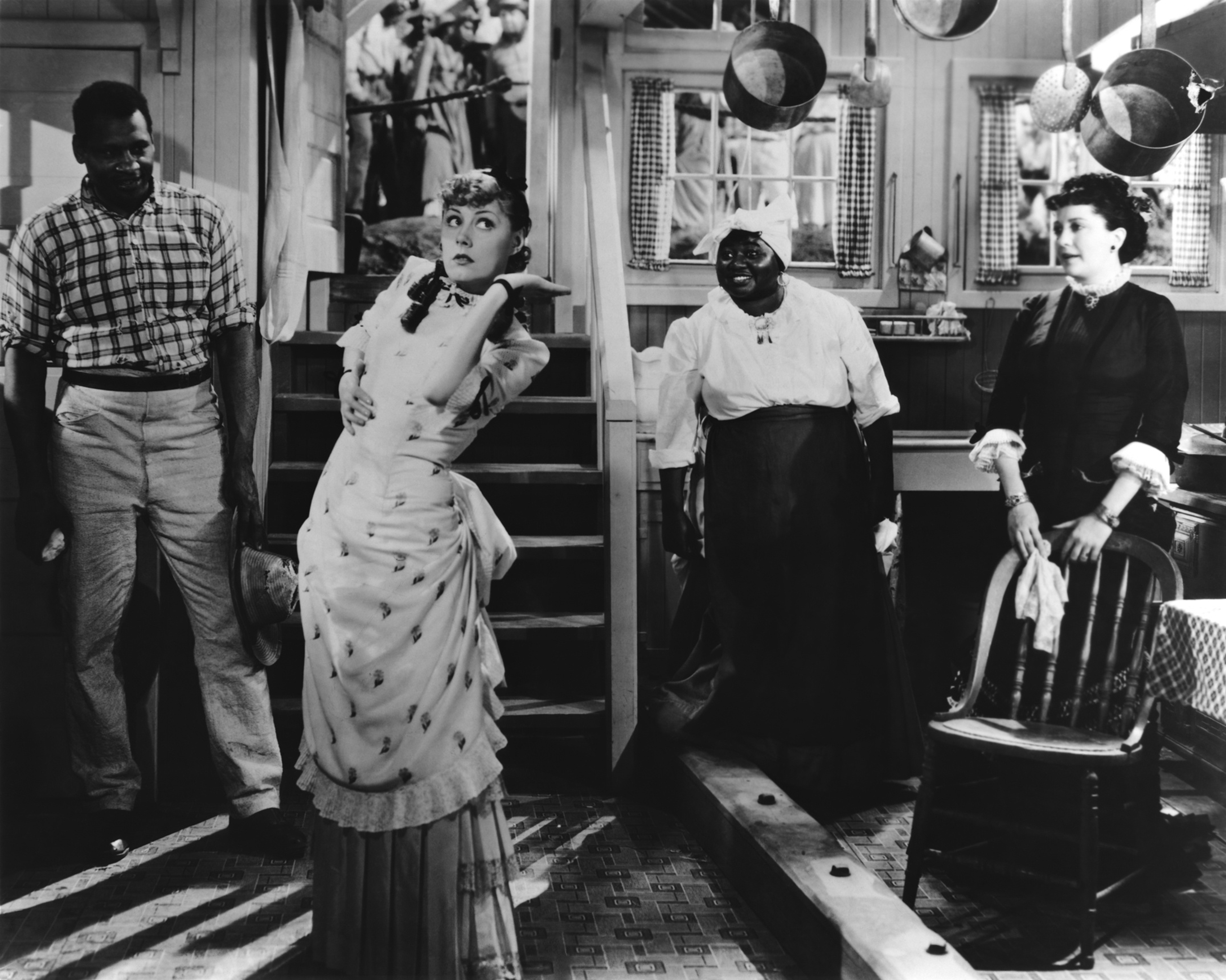
This handsome, eloquent and highly charismatic actor became one of the
foremost interpreters of
Eugene O'Neill's plays and one of
the most treasured names in song during the first half of the twentieth
century. He also courted disdain and public controversy for most of his
career as a staunch Cold War-era advocate for human rights, as well as his very vocal support for Joseph Stalin and the Soviet invasion of Hungary in 1956. While the
backlash of his civil rights activities and left-wing ideology left him
embittered and practically ruined his career, he remains today a
durable symbol of racial pride and consciousness.
Born in Princeton, New Jersey, on April 9, 1898, Paul LeRoy Bustill
Robeson and his four siblings (William, Benjamin, Reeve, Marian) lost
their mother, a schoolteacher, in a fire while quite young (Paul was
only six). Paul's father, a humble Presbyterian minister and former
slave, raised the family singlehandedly and the young, impressionable
boy grew up singing spirituals in his father's church. Paul was a
natural athlete and the tall (6'3"), strapping high school fullback had
no trouble earning a scholarship to prestigious Rutgers University in
1915 at age 17 -- becoming only the third member of his race to be
admitted at the time. He excelled in football, baseball, basketball,
and track and field, graduating as a four-letter man. He was also the
holder of a Phi Beta Kappa key in his junior year and was a selected
member of their honorary society, Cap and Skull. Moreover, he was the
class valedictorian and in his speech was already preaching idealism.
Paul subsequently played professional football to earn money while
attending Columbia University's law school, and also took part in
amateur dramatics. During this time he met and married Eslanda Cardozo
Goode in 1921. She eventually became his personal assistant. Despite
the fact that he was admitted to the New York bar, Paul's future as an
actor was destined and he never did practice law. His wife persuaded
him to play a role in "Simon the Cyrenian" at the Harlem YMCA in 1921.
This was followed by his Broadway debut the following year in the
short-lived play "Taboo", a drama set in Africa, which also went to
London. As a result, he was asked to join the Provincetown Players, a
Greenwich Village theater group that included in its membership
playwright Eugene O'Neill. O'Neill personally asked Paul to star in his
plays "All God's Chillun Got Wings" and "The Emperor Jones" in 1924.
The reaction from both critics and audiences alike was
electrifying...an actor was born.
In 1925 Paul delivered his first singing recital and also made his film
debut starring in
Body and Soul (1925), a rather
murky melodrama that nevertheless was ahead of its time in its
depictions of black characters. Although Robeson played a scurrilous,
corrupt clergyman who takes advantage of his own people, his dynamic
personality managed to shine through. Radio and recordings helped
spread his name across foreign waters. His resonant bass was a major
highlight in the London production of "Show Boat" particularly with his
powerful rendition of "Ol' Man River." He remained in London to play
the role of Shakespeare's "Othello" in 1930 (at the time no U.S.
company would hire him), and was again significant in a highly
controversial production. Paul caused a slight stir by co-starring
opposite a white actress,
Peggy Ashcroft,
who played Desdemona. Around this time Paul starred in the landmark
British film
Borderline (1930), a
silent film that dealt strongly with racial themes, and then returned
to the stage in the O'Neill play "The Hairy Ape" in 1931. The following
year he appeared in a Broadway revival of "Show Boat" again as Joe. In
the same production, the noted chanteuse
Helen Morgan repeated her original
1927 performance as the half-caste role of Julie, but the white actress
Tess Gardella played the role of Queenie
in her customary blackface opposite Robeson.
Robeson spent most of his time singing and performing in England
throughout the 1930s. He also was given the opportunity to recapture
two of his greatest stage successes on film:
The Emperor Jones (1933) and
Show Boat (1936). In Britain he
continued to film sporadically with
Sanders of the River (1935),
Song of Freedom (1936),
King Solomon's Mines (1937),
Dark Sands (1937) and
The Tunnel (1940) in
important roles that resisted demeaning stereotypes.
During the 1930s he also gravitated strongly towards economics and
politics with a burgeoning interest in social activism. In 1934 he made
the first of several trips to the Soviet Union and outwardly extolled
the Soviet way of life and his belief that it lacked racial bias, despite the Holodomor and the later Rootless Cosmopolitan Campaign. He was a popular
figure in Wales where he became personally involved in their civil
rights affairs, notably the Welsh miners. Developing a marked leftist
ideology, he continued to criticize the blatant discrimination he found
so prevalent in America.
The 1940s was a mixture of performance triumphs and poignant, political
upheavals. While his title run in the musical drama "John Henry"
(1940), was short-lived, he earned widespread acclaim for his Broadway
"Othello" in 1943 opposite
José Ferrer as Iago and
Uta Hagen as Desdemona. By this time, however,
Robeson was being reviled by much of white America for his outspoken
civil rights speeches against segregation and lynchings, particularly
in the South. A founder of the Progressive Party, an independent
political party, his outdoor concerts sometimes ignited violence and he
was now a full-blown target for "Red Menace" agitators. In 1946 he
denied under oath being a member of the Communist Party, but
steadfastly refused to refute the accusations under subsequent probes.
As a result, his passport was withdrawn and he became engaged in legal
battles for nearly a decade in order to retrieve it. Adding fuel to the
fire was his only son's (Paul Jr.) marriage to a white woman in 1949
and his being awarded the Stalin Peace Prize in 1952 (he was unable to
receive it until 1958 when his passport was returned to him).
Essentially blacklisted, tainted press statements continued to hound
him. He began performing less and less in America. Despite his growing
scorn towards America, he never gave up his American citizenship
although the anguish of it all led to a couple of suicide attempts,
nervous breakdowns and a dependency on drugs. Europe was a different
story. The people continued to hold him in high regard as an
artist/concertist above reproach. He had a command of about 20
languages and wound up giving his last acting performance in "Othello"
on foreign shores -- at Stratford-on-Avon in 1959.
While still performing in the 1960s, his health suddenly took a turn
for the worse and he finally returned to the United States in 1963. His
poet/wife
Eslanda Robeson died of cancer
two years later. Paul remained in poor health for pretty much the rest
of his life. His last years were spent in Harlem in near-total
isolation, denying all interviews and public correspondence, although
he was honored for speaking out against apartheid in South Africa in
1978.
Paul died at age 77 of complications from a stroke. Among his many
honors: he was inducted into the College Football Hall of Fame in 1995;
he received a Grammy Lifetime Achievement Award in 1998; was honored
with a postage stamp during the "Black Heritage" series; and both a
Cultural Center at Penn State University and a high school in Brooklyn
bear his name. In 1995 his autobiography "Here I Stand" was published
in England in 1958; his son,
Paul Robeson Jr., also chronicled a
book about his father, "Undiscovered Paul Robeson: An Artist's Journey"
in 2001.

 Tales of Manhattan(1942)as Luke
 Native Land(1942)as Narrator, Vocalist
 The Tunnel(1940)as David
 Dark Sands(1937)as Cpl. Jericho Jackson
 King Solomon's Mines(1937)as Umbopa

 EastEnders(1985)
 The Procession(2019)
 Genius(2017)
 Indignation(2016)
 Pride(2014)
 Ego zvali Robson(1998)as Self
 The Tallest Tree in Our Forest(1977)as Self
 Nationalkultur in der DDR(1971)as Self
 This Is Your Life(1955)as Self
 Alabama Jubilee(1960)as Self
 Compression(1995)as Self
 7.30(2006)as Self - Actor, Show Boat
 Hollywood Black(2024)as Self
 Unsung Presents: Best in Black(2023)as Self
 Uncle Tom II: An American Odyssey(2022)as Self