Stanislav Rostotsky was a renown Russian film director whose two films,
The Dawns Here Are Quiet (1972) and
White Bim Black Ear (1977)
were nominated for Oscar and won other international awards.
He was born Stanislav Iosifovich Rostotsky on April 21, 1922, in
Rybinsk, north of Moscow, Russia. His father, named Josef Boleslavovich
Rostotsky, was a respected Medical Doctor and later became an official
at State Department of Health. His mother, named Lidia Karlovna, was a
homemaker. Young Rostotsky spent much of his childhood in a village in
Central Russia. There he developed his special ability to uncover the
beauty of wild nature, that later became a professional forte in his
directing.
In 1936, at age 14, Rostotsky made his film debut as an actor in
Bezhin lug (1937), albeit some parts
of the film were lost, including most of Rostotsky's scenes. At that
time he met the legendary director
Sergei Eisenstein. Under the
guidance from Eisenstein, young Rostotsky studied literature and arts,
and focused on such writers as
Honoré de Balzac and
Émile Zola, composers
Claude Debussy and
Maurice Ravel, art of Japanese prints and
Impressionist paintings by such artists as
Pierre-Auguste Renoir and
Edgar Degas among others. Rostotsky and
Eisenstein became life-long friends. Upon Eisenstein's advise,
Rostotsky did not rush into film business until he achieved a
well-rounded education, he attended Moscow Institute of Philosophy and
Literature.
In February 1942 Rostotsky was drafted in the Red Army. After a brief
training, he served as a private with the 6th Cavalry Guards Brigade at
the Ukrainian Front, fighting against the Nazi troops during the Second
World War. On February 11, 1944 Rostotsky was severely wounded in
action; after having his leg amputated he undergone a comprehensive
six-month treatment, and had to wear a prosthesis for the rest of his
life. Rostotsky was decorated with the Order of the Red Banner for his
courage in battle.
In August of 1944 Rostotsky became a student of director
Grigoriy Kozintsev at Leningrad
Institute of Cinematography. There he studied film directing for seven
years, assisted in Kozintsev's films, and graduated in 1951 as a film
director. From 1952 to 2001 he worked at Gorky Film Studio in Moscow.
There he made 17 films as director, including his best films,
We'll Live Till Monday (1968),
'A zori zdes tikhie' (1972), and 'Belyy Bim - chernoe ukho' (1977), the
latter two received Oscar nominations and international acclaim.
Stanislav Rostotsky was awarded the State Prize of the USSR twice
(1970, 1975). He was designated People's Artist of the USSR, and
received numerous awards and decorations for his contribution to film
art. He was a Member of the Board of Union of Cinematographers, and
five times Member of the Jury at Moscow International Film Festival
(1975, 1977, 1979, 1981, 1983). He also taught directing at State
Institute of Cinematography in Moscow, and wrote numerous articles on
film directing and film history. He also wrote memoirs about
Eisenstein, Gerasimov, Moskvin, and other Russian film figures.
Rostotsky was married to notable Russian actress
Nina Menshikova and their son,
Andrey Rostotskiy was a popular film
actor.
Outside of his film profession Stanislav Rostotsky was famous for his
support of recreational fishing and was known for releasing his catch
alive; he was decorated with the Medal of Honor "For Development of
Fishing Resouces in Russia" and also presided at several sport fishing
competitions. Stanislav Rostotsky died of a heart failure on August 11,
2001, in Moscow, and was laid to rest in Vagankovskoe Cemetery in
Moscow, Russia.

 Iz zhizni Fyodora Kuzkina(1989)
 Trees Grow on the Stones Too(1985)
 Eskadron gusar letuchikh(1981)
 White Bim Black Ear(1977)
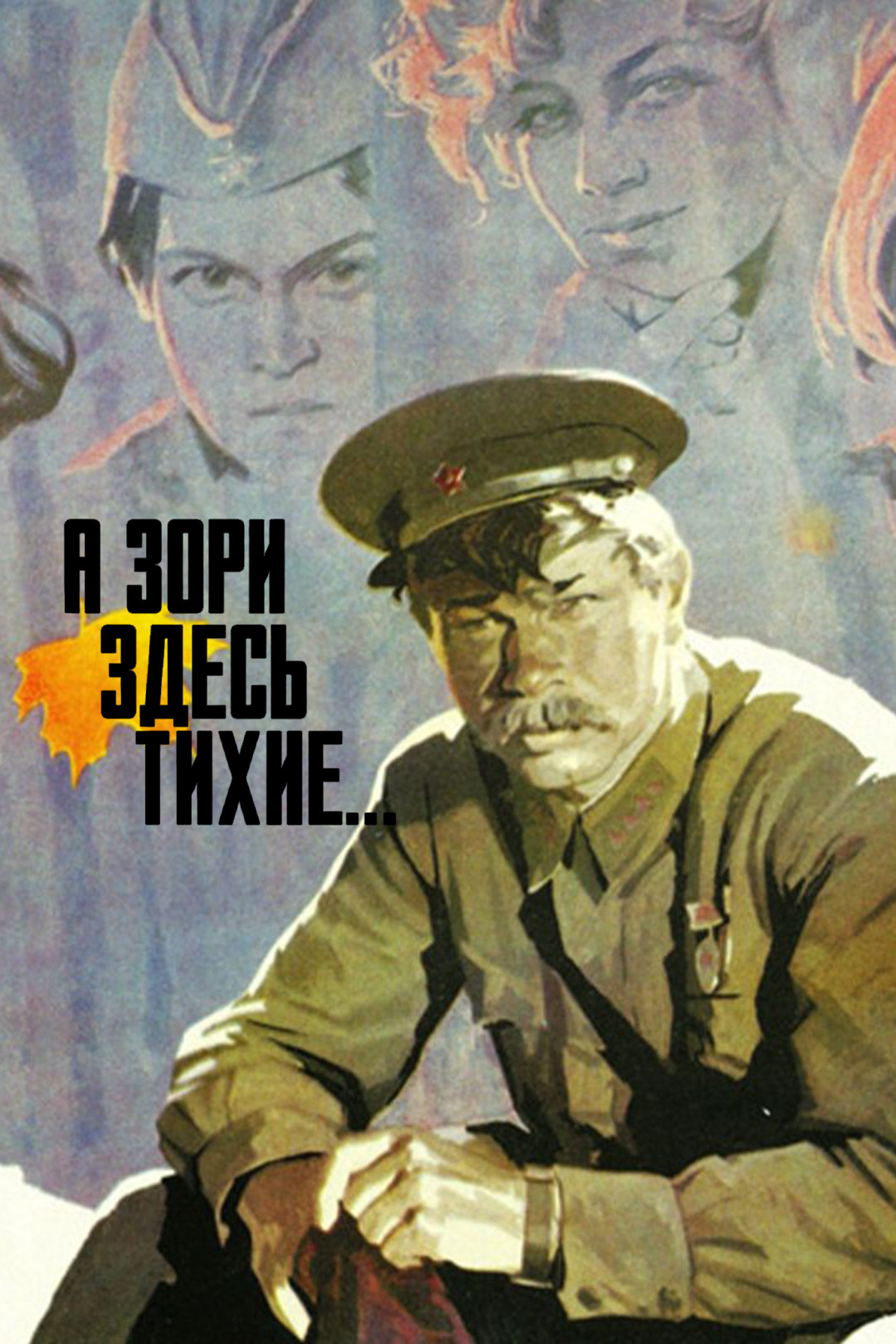 The Dawns Here Are Quiet(1972)
 Geroy nashego vremeni(1967)
 Na nozhakh(1998)
 Bezhin lug(1937)as Boy
 Pyatnadtsataya vesna(1972)
 Tainstvennaya nakhodka(1954)
 Tri dnya Viktora Chernyshova(1968)
 Chtoby pomnili(1993)as Self
 Sovetskoye kino(1965)as Self
 Kak ukhodili kumiry(2005)as Self


