The famous columnist Sidney Skolsky, who perhaps has the best claim to
having invented the term "Oscar" for the Academy of Motion Picture Arts
& Sciences Award of Merit (the official name of the Academy Award,
which bore the inscription "First Award for Merit" up until the 1950s),
was born in New York City in 1903. A graduate of New York University,
he became a Broadway press agent, then graduated to the newspapers,
becoming a Broadway columnist in 1929.
Skolsky's column was yclept "Times Square Tintypes" and offered
typewriter-written caricatures (tintypes) of the leading lights of
Broadway (those that didn't come powered by Con Edison). These
"tintypes" were a staple of Skolsky's journalism career, and while he
was never as powerful as
Walter Winchell
or as famous as
Mark Hellinger, he did --
like Hellinger -- become a movie producer, though not as successful as
his fellow New York scribe.
In 1932, Skolsky left the Big Town (a.k.a. The Big Apple) for Lotus
Land (a.k.a. Tinseltown or LA-LA Land for those seeking to make an
eponym out of the name of the City of Angels). He made Schwabb's
drugstore famous in his nationally syndicated gossip column, as that
was his headquarters, where he worked on his column gathering the
skinny on Hollywood. He became one of the premier entertainment
reporters of his time, dishing scoops of celebrity corn and
confabulations.
His column and stories appeared in the flagship New York Post on the
East Coast and in the Los Angeles Herald on the Left, and was carried
by many other newspapers. It was perhaps inevitable, being in such
close proximity to the Dream Machine, that Skolsky would be called on
to spin some tales of his own for the silver screen. He co-wrote the
story for
The Daring Young Man (1935)
for fellow writer
Darryl F. Zanuck at
20th Century-Fox, and produced
The Jolson Story (1946) for
Harry Cohn's Columbia and
The Eddie Cantor Story (1953)
for the brothers Warner. He also made cameo appearances as himself in
several films, including
Billy Wilder's
classic Hollywood tale
Sunset Boulevard (1950) and
Robert Aldrich's unspeakable take on the
Greta Garbo mystique,
The Legend of Lylah Clare (1968),
which featured
Kim Novak spouting
gibberish clad only in a brassiere and a German accent.
In addition to his movie appearances, Skolsky also worked on radio and
television, helming "Sidney Skolsky's Hollywood." He also contributed
to the TV series
Hollywood: The Golden Years (1961),
produced by
David L. Wolper.
He played a role in
Marilyn Monroe's rise
from bit-part player to star in the early 1950s. Upon meeting Skolsky
in 1950, Monroe confessed that
Jean Harlow
had been her role model her entire life, Skolsky, who had known Harlow,
decided to help Monroe become a star, and for several years he
mentioned her in his column and used his pull with the studios to get
her better roles. She made it, and the pair planned to make a Harlow
movie together.
Skolsky's greatest claim to fame arguably is his contribution of the
nickname "Oscar" to the Academy Award. Although the Academy of Motion
Picture Arts and Sciences does not attribute the nickname to a specific
person (longtime Academy librarian Margaret Herrick was one of the
claimants to originating the moniker), it does cite Skolsky's use of
the term in a 1934 column tagging the name "Oscar" to
Katharine Hepburn's first First Award
for Merit from the Academy. The Academy stops short of admitting that
this was the first instance where the Award was called "Oscar" in
print, which it was. On his part, Skolksy claimed that his use of the
term referenced an old vaudeville joke that began, "Will you have a
cigar, Oscar?" The gist of the joke was that the Academy's First Award
for Merit was little better than a tchotchke of dubious value.
Skolsky published his memoirs in 1975, using his famous closing line
from his columns, "Don't Get Me Wrong, I Love Hollywood," as the title
for his autobiography. He died in 1982, and his widow donated his
papers to the Academy Library, which is named after fellow Oscar
"namer" Margaret Herrick.
 The Eddie Cantor Story(1953)
 The Daring Young Man(1935)
 Don't Make Waves(1967)as Reporter
 Follow the Sun(1961)as Reporter
 The Right Approach(1961)as Newspaper Columnist
 Teacher's Pet(1958)as Sidney Skolsky
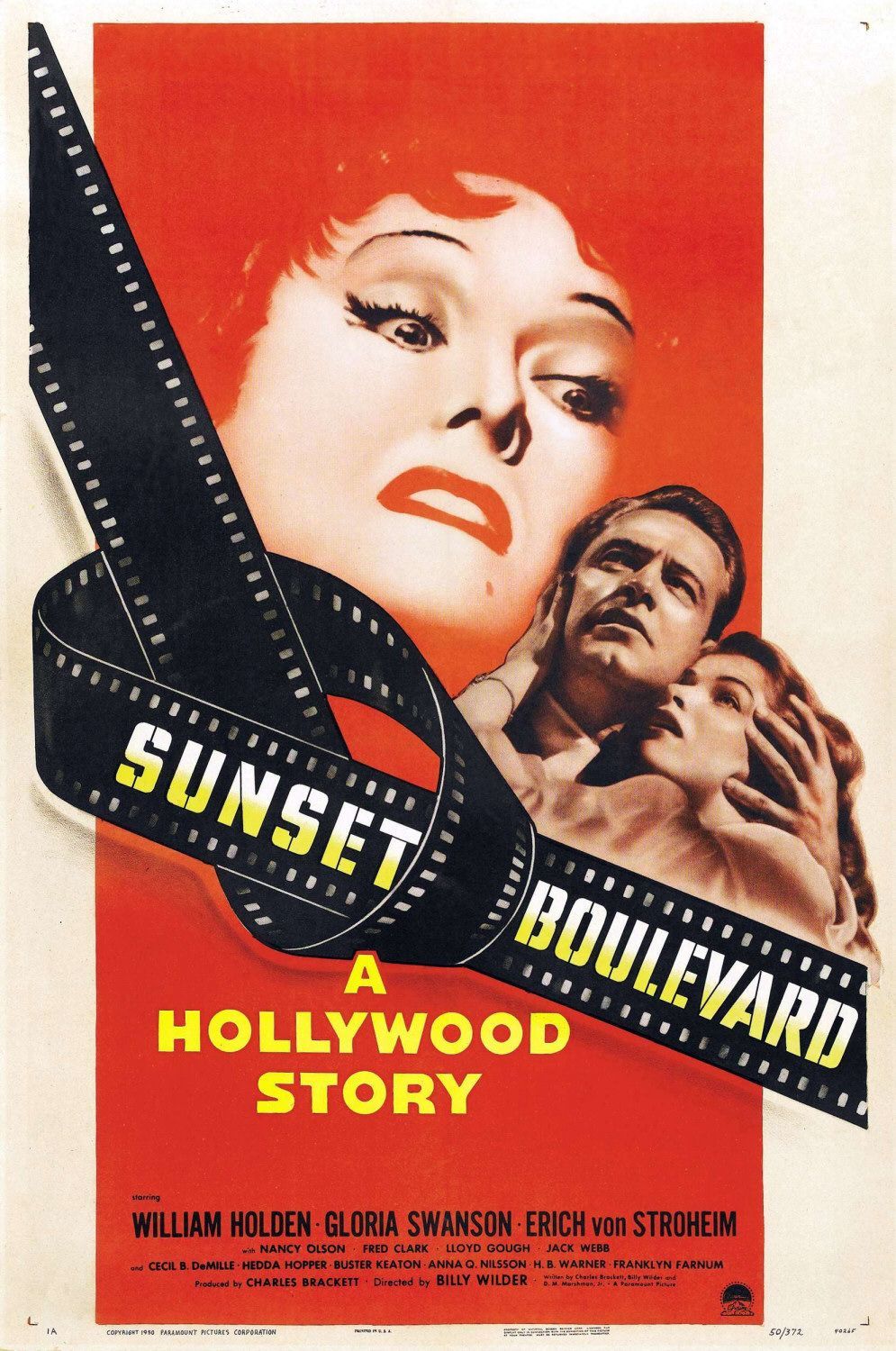 Sunset Boulevard(1950)as Sidney Skolsky
 The Jolson Story(1946)
 The Merv Griffin Show(1962)as Self - columnist
 Tomorrow Coast to Coast(1973)as Self
 The Joey Bishop Show(1967)as Self
 The Legend of Lylah Clare(1968)as Self
 Your First Impression(1961)as Self - celebrity guest
 Fascination: An Unauthorized Tribute to Marilyn Monroe(2011)as Self
 Legends(2006)as Sidney Skolsky


