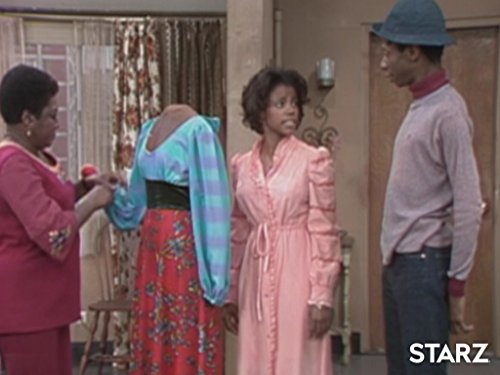
He symbolized the 70s American dream of success -- the former kid from
the ghetto who rose to wisecracking TV superstardom. While in his
element as the broadly strutting, gleamy-toothed J.J. Evans of the
popular urban-styled sitcom
Good Times (1974), Jimmie Walker
lived the extremely good life. Following the series' demise, however,
reality again checked in. Still and all, he has not self-destructed as
others before him have and continues to enjoy a comedy career now
approaching four decades.
Jimmie was born on June 25, 1947, in New York's tough South Bronx
neighborhood. His ambitions were not originally to entertain.
Basketball was his prime interest but the idea that a gawky,
stringbean-framed teenager could become a hoop star did not seem
realistic. Instead he abruptly quit school and worked an odd assortment
of jobs until wisely returning to night classes at Theodore Roosevelt
High School and redeeming himself with a diploma. The federally-funded
Search for Education, Evaluation and Knowledge (SEEK) next came through
for Jimmie as he was able to learn a trade: radio
engineering/announcing. Within a year he was hired as an engineer for a
small radio station, but gained a minor reputation on the sly as a
funny guy and good writer. This side interest is what motivated Jimmie
to try comedy performance.
He made his stand-up debut as an opening act on New Year's Eve in 1967
for "The Last Poets," a militant poetry group, and was such a hit that
he stayed with the group for a year and a half building and polishing
his jive-styled act. At one point Jimmie was seen at a Manhattan club
by comedian
David Brenner who
referred him and others (such as
Freddie Prinze) to Budd Friedman and his
Improv stage in New York. Jimmie eventually became a regular. His debut
shot on TV variety came with
Jack Paar's show and his successful
1972 appearance propelled him to main attraction billing.
He was quickly checked out by the
Norman Lear team and practically handed
stardom on a silver platter with
Good Times (1974), a spin-off of
Esther Rolle's domestic character on the
popular
Maude (1972) series. Skinny,
energetic and youthful-looking with plenty of harmless sass and
attitude, Jimmie and the show were instant cross-over hits despite the
fact that he was a 27-year-old playing the teenage son of Rolle. His
catchphrase "Dyn-o-mite!" became a popular item in the American
vernacular. Jimmie became such a major celebrity that Time Magazine
named him "Comedian of the Decade." Clothing, belts, and even a talking
doll that blurted out his familiar phrase were soon on the open market.
To the dismay of other actors on the show, his exaggerated character
stole prime focus and shifted the well-intentioned direction of a
positive black family image into a much broader and stereotyped
caricature. This caused dissension in the troops and both adult leads,
Ms. Rolle and
John Amos, departed the
series (Rolle came back later). Nevertheless, the series managed to
last six seasons.
During that time Jimmie made use of his ever-surging popularity with
lightweight appearances elsewhere on primetime ("The Love Boat,"
"Fantasy Island") and on game shows ("The Match Game," "Tattletales").
He became a hot item in Las Vegas and even churned out a best-selling
comedy album entitled, of course, "Dyn-o-mite!" His attempt at film
stardom came with a top supporting role in
Let's Do It Again (1975)
starring
Sidney Poitier and
Bill Cosby, a comedy that also featured his
TV dad
John Amos. Jimmie was featured
as a highly unlikely, scrawny-framed boxer promoted by Poitier and
Cosby. As enjoyable as he was, it did not lead to other major film
offers. Most of his later movies have been self-mocking guest parts or
cameo bits in spoofs such as in
Airplane! (1980), the Frankenstein
take-off
Monster Mash: The Movie (1995)
and the slasher movie parody
Shriek If You Know What I Did Last Friday the Thirteenth (2000).
Upon the series' demise in 1979, Jimmie returned to the stand-up stage
while looking for a sophomore TV hit. Unable to capitalize on his TV
stardom, he instead found himself extremely pigeon-holed by the J.J.
character. The short-lived
B.A.D. Cats (1980), which had him
playing a support role as a comic car thief-cum-repossessor, lasted
only a month. The military comedy
At Ease (1983) had Jimmie starring as
a Sergeant Bilko-like conman. It too came and went quickly. Hoping the
third time would be a charm, Jimmie was a bust again in the syndicated
show
Bustin' Loose (1987),
based loosely on
Richard Pryor's 1981
movie, with the comedian playing another of his genial con artists.
Jimmie's main focus has remained the stand-up circuit, touring an
average of 25-30 weeks a year. The rubbery-faced, tunnel-mouthed comic
continues to pop up occasionally on the late night talk show forum. In
his spare time he writes scripts for TV and films.


 Good Times(2024)as Jim Bean
 CHAAW: Chapter 3 - Christmas Time Is Here(2024)as Uncle Jr.
 Don't Suck(2023)as Dale
 The Bold and the Beautiful(1987)as Count Bouche
 A Wrestling Christmas Miracle(2020)as Dr. Lemon
 Surely, You Jest(2019)
 The Improv: 50 Years Behind the Brick Wall(2013)
 Good Times(1974)
 Comics Unleashed(2006)as Guest, Self
 Seen & Heard: The History of Black Television(2025)as Self
 Sherri(2022)as Self
 6th Urban One Honors 2024(2024)as Self
 TV We Love(2025)as Self
 Last Week Tonight with John Oliver(2014)as Self
 Entertainment Tonight(1981)as Self
 Gary(2024)as Self - Actor
 Love to Love You, Donna Summer(2023)as Self