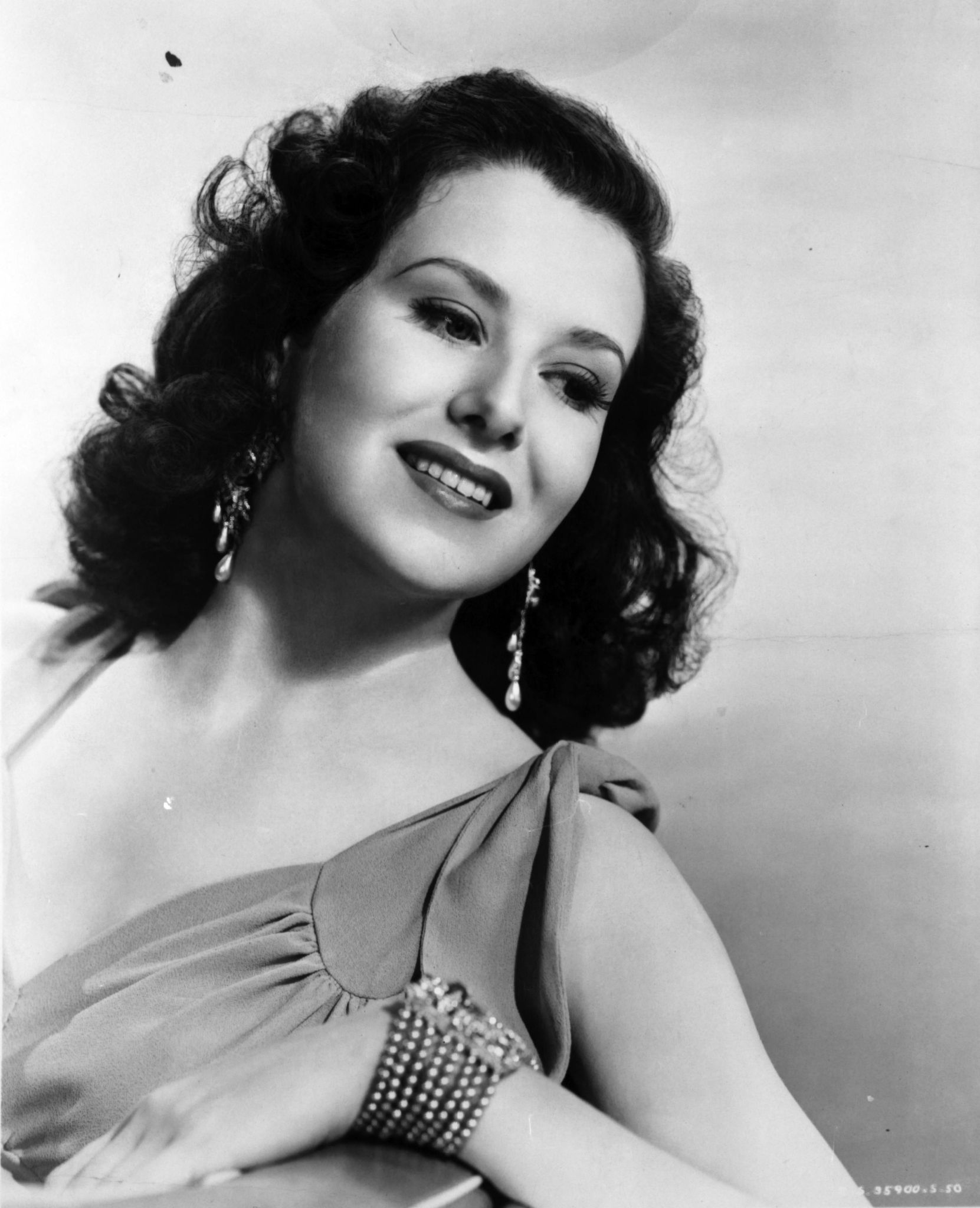
Reedy and regal actress Ruth Warrick will be remembered for two names
and two names alone. In films, she will indelibly be referred to as the
castoff first "Mrs. Citizen Kane," and on TV she will forever be
synonymous with her character of Phoebe Tyler Wallingford, the
obnoxiously wealthy, viper-tongued, manipulative and meddlesome Pine
Valley grande dame who held court for 35 years until her death in 2005.
Born in St. Joseph, Missouri in 1915, Ruth moved to Kansas City while
in high school and later studied at the University of Kansas City. An
essay contest winner, a resulting promotional tour brought her to New
York where her interest in acting was increasingly piqued.
Stage-trained in New York, she appeared in such plays as "Bury the
Dead" (1933) and was a radio singer at one point. She met her first
husband during one her many broadcasts. This in turn led her to
Orson Welles
and his Mercury Theater, and the rest is history. In 1941 Welles
escorted her and his company of members to Hollywood...and major
stardom.
Exclusively chosen by Welles to make her ladylike debut as Emily Norton
Kane in what most consider the greatest American film of all time, she
followed
Citizen Kane (1941) with nearly two dozen films, most of which were "B"
melodramas and rugged adventures. She could play the altruistic wife
with stoic ease but enjoyed more enthusiastic notices when controlling,
tightly-wound or neurotic. Appearing with some of Hollywood's most
illustrious male and female stars, she played a countess opposite
Douglas Fairbanks Jr. in
The Corsican Brothers (1941); co-starred with Mercury Theater compatriots
Joseph Cotten,
Agnes Moorehead and
Everett Sloane in the classic film noir
Journey Into Fear (1943); and
starred in several war-themed movies including
Secret Command (1944) with
Chester Morris,
Mr. Winkle Goes to War (1944) with
Edward G. Robinson, and
China Sky (1945), with 'Randolph Scott' (I).
Post-war credits tended to regress her to second lead status opposite
the likes of
Joan Crawford and
Ingrid Bergman, yet she still managed a few top femme
roles in such films as
Driftwood (1947) and
One Too Many (1950), the latter in which she
played an alcoholic.
The focus of Ruth's career switched to the "Golden Age" of TV in the
1950s. Aside from her many live dramatic showcases, she made a lasting
mark in daytime soap opera. Her tight-lipped matrons on
Guiding Light (1952) and
As the World Turns (1956) were only a warm-up for her once-in-a-lifetime portrayal of one
of daytime's most dominant, colorful and enduring characters. Cast on
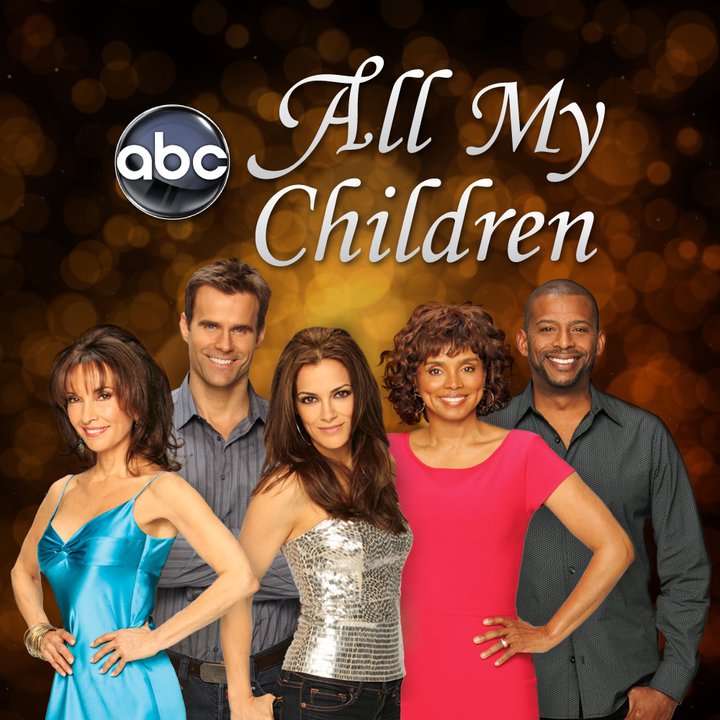
All My Children (1970) from the show's inception, Phoebe Tyler became a clear and
instant favorite -- the lady you relished hating. Her priggish
socialite character carried strong story lines for nearly two decades
until advancing age and failing health restricted her time. Her
well-received (and aptly titled) autobiography "The Confessions of
Phoebe Tyler" (1980) chronicled the lives of both her and her
alter-ego. Prime time also made use of Ruth's sudsy-styled talent as
her Emmy nomination for the role of Hannah Cord in
Peyton Place (1964) will attest.
Making her Broadway debut with "Miss Lonelyhearts" in 1957, Ruth's
talents also included singing and, in between on-screen assignments,
enjoyed the musical stage now and then. She understudied in "Take Me
Along" (1959) with
Jackie Gleason and in 1973 enjoyed a successful return to
Broadway with the revival of "Irene" starring
Debbie Reynolds. In regional and
summer theater she starred in "Dial M for Murder," "Who's Afraid of
Virginia Woolf?" and "Long Day's Journey Into Night," among others. She
also toured as Anna in "The King and I" and appeared in the musicals
"Pal Joey" and "Roberta."
Her life, however, was not dedicated to just on-camera pursuits. On the
contrary, long active in arts-in-education programs, including programs
for the disadvantaged, Ruth received the first national Arts in
Education Award in 1983 from the Board of Directors of Business and
Industry for Arts in Education, Inc. The award was subsequently named
the Ruth Warrick Award for Arts in Education and continued to be given
annually. In 1991, she received her certification as a licensed
metaphysical teacher. In her senior years, she became an avid
spokesperson for the rights of senior citizens as well as the disabled,
and was appointed to the U.N. World Women's Committee on Mental Health.
In frail health in later years, the still feisty, six-times-
married-and-divorced actress made occasional appearances on her beloved
daytime show, even while confined to a wheelchair after a serious fall
in 2001. She made her final appearance on the show in early January,
2005 to commemorate its 35th anniversary, and passed away shortly after
at age 89 of complications from pneumonia.
 All My Children(1970)as Phoebe Tyler Wallingford, Phoebe Tyler
 Loving(1983)as Phoebe Tyler Wallingford
 Peyton Place: The Next Generation(1985)as Hannah Cord
 Death Mask(1984)as Beatrice VandenBerg
 The Returning(1983)as Grace
 Complicated Women(2003)
 SoapTalk(2002)
 The Iron Major(1943)
 Michael Jackson: 30th Anniversary Celebration(2001)as Self
 E! Mysteries & Scandals(1998)as Self
 Captured on Film: The True Story of Marion Davies(2001)as Self
 Live with Kelly and Mark(1988)as Self - Guest
 Compression(1995)as Self
 Home & Family(2012)as Self
 Magician: The Astonishing Life and Work of Orson Welles(2014)as Emily Monroe Norton Kane (clip from Citizen Kane (1941))