Sol Hurok was the legendary impresario who made the impossible
breakthrough by bringing the Bolshoi Theatre Ballet to America During
the Cuban Missile crisis. At that time he managed to separate the
Russian art and culture from the Soviet politics of the day.
He was born Solomon Israilevich Gurkov on April 9, 1888, in Pogar, near
Kharkov, Russia (now Kharkiv, Ukraine). He was the third son in a
traditional Russian-Jewish family. His father, Israil Gurkov, was a
retail trader. Young Hurok was a good balalaika player, albeit he was
largely self-taught. He also worked for his father's business. At the
age of 18, he was sent to study at the Kharkov Trade School, but
instead he used all his money to emigrate to America in May, 1906,
together with his girlfriend, Tamara Shapiro. They married in 1908 and
had a daughter. In America, he changed his name to Sol Hurok, and
learned English in addition to his native Russian and Yiddish. He was a
peddler, streetcar conductor, bottle-washer, and hardware salesman
before becoming the foremost impresario of his time. He became a
naturalized American citizen in 1914.
Sol Hurok was a very inventive show promoter. In 1913, he inaugurated
the popular concert series "Music for the Masses." By his own
estimation, Hurok represented about four thousand artists and
companies. His work was focused mainly on the Russian stars of music,
opera, and ballet. He represented such performers as
Efrem Zimbalist Sr.,
David Oistrakh, Leonid Kogan, Viktor
Tretyakov, Valeri Klimov,
Mstislav Rostropovich, opera
singers
Feodor Chaliapin Sr.,
Yelena Obraztsova,
Irina Arkhipova,
Galina Vishnevskaya, Zara
Dolukhanova, ballet dancers
Mikhail Fokin,
Anna Pavlova,
Isadora Duncan,
Galina Ulanova, pianists
Artur Rubinstein,
Svyatoslav Richter,
Emil Gilels,
Vladimir Ashkenazy, and also brought
pianist
Van Cliburn to Russia, among many
others.
In 1935, in Paris, Hurok was introduced to singer
Marian Anderson by the pianist
Rubinstein. He was very impressed with her talent and organized her
concerts in the United States. At that time any black performer could
not be welcomed by most "elitist" concert halls in America. Sol Hurok
managed to overcome that; he staged an open air performance for Marian
Anderson at the Lincoln Memorial on April 9, 1939. Anderson sang to the
crowd of 75 thousands with such a tremendous success, that she became
an overnight celebrity, and was invited to the White House by the first
lady
Eleanor Roosevelt.
During the 1920s and 30s, Hurok managed American tours of the
Diaghilev's Ballet Russe and also the Ballet Russe de Monte Carlo. In
the 30s, 40s, and 50s, he brought theatrical companies from Europe,
Russia, and Israel, such as Habima Players, Moscow Art Theatre, Comédie
Française, and the Old Vic, among others. On one occasion, Hurok was
asked by
Joseph Stalin to "Bring Feodor
Chaliapin back to Moscow." Stalin promised big money and glory to many
famous Russian émigrés if they return, but Hurok's answer to Stalin was
"No." In 1946 Hurok published his autobiography, 'Impresario', and the
book was later adapted into film
Tonight We Sing (1953) by
director
Mitchell Leisen.
Hurok's major achievements in the 60s were the impeccably organized
international tours of the Bolshoi Theatre with it's famous large-scale
Russian operas and ballets. He later organized numerous international
tours for the Kirov Ballet of Leningrad (St. Petersburg), Russia. He
also brought the Moscow Art Theatre and the 'Beriozka' ensemble on
several tours to the United States. Hurok made the impossible
breakthrough by bringing the Bolshoi Theatre Ballet to America During
the Cuban Missile crisis. At that time he managed to separate the
Russian art and culture from the Soviet politics of the day.
In 1972 Sol Hurok was injured by explosion of a bomb planted in his
office, one of his staff receptionists was killed, several more were
injured. However, Hurok continued his work on Russian - American
projects, such as his
Rudolf Nureyev
project involving sponsorship from David Rockefeller. Hurok died of a
heart attack en route to a meeting with David Rockefeller on March 5,
1974, in New York. The service was held at the Carnegie Hall, where
thousands came, including many internationally renown performers. The
last word was said by Hurok's protégé
Marian Anderson.
 Tonight We Sing(1953)
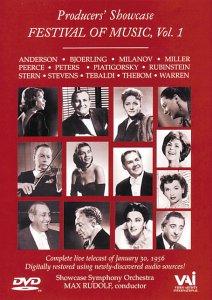 Producers' Showcase(1954)
 Of Men and Music(1951)
 The Gay Parisian(1941)
 I Am Suzanne!(1933)
 The Mike Douglas Show(1961)as Self - Impresario
 Philbin's People(1969)as Self
 The David Frost Show(1969)as Self
 The Dick Cavett Show(1968)as Self