Mikhail Sholokhov was a Russian writer who received a Nobel prize for
his epic novel 'Tikhiy Don'.
He was born in 1905 into a Cossack family of farmers in Kruzhilin,
Veshenskaya, Rostov province in Southern Russia. His high school
studies were interrupted by the Russian revolution and the Civil War,
in which he fought on the side of the revolutionaries and joined the
Red Army. From 1922-24 he lived in Moscow, where he attended "writers
seminars" and published his early works: "A Test" and "The Birthmark".
In 1924 he married Maria Gromoslavskaya in his native town, and the
couple had four children.
His first book, "Donskie Rasskazy" (1925), exposed the bitter divide
among the Russian people during and after the Civil War. His epic novel
"And Quiet Flows the Don", published in parts during 1928-40, shows the
turbulent life of Cossacks during the dramatic events of the Russian
revolution and Civil War. The main character, Grigori Melekhov, was
based on a historical prototype, 'Kharlampi Ermakov', a Cossack who
opposed the Communists and was imprisoned and executed in 1929.
Sholokhov's account of the conflict between Cossacks and Communists
caused a suspension of publication in 1929, but he managed to get
permission from
Joseph Stalin to continue
the publication. The novel had over 100 million copies in print,
translated in 90+ languages worldwide.
Sholokhov was only 22 in 1928, when he delivered the massive manuscript
of "Quiet Flows the Don" (book 1) to a Soviet publisher. It took him
almost 14 years to complete the novel of four books in 1940. This led
to a suggestion by
Aleksandr Solzhenitsyn that
Sholokhov used the work of another Cossack writer, Fyodor Kryukov (who
died in 1920), for some parts of this epic work.
Sholokhov had a lifelong political career. He was a co-chairman of the
Soviet Writers Union from the 1930s to his death in 1984. He traveled
in western Europe on several occasions, and also accompanied Soviet
leader
Nikita Khrushchev to the US in
1959. He was awarded the 1965 Nobel Prize for Literature for his novels
and stories about the Cossacks in Russia, becoming the first and only
officially sanctioned Soviet writer to win the honor.
Sholokhov took a hardline position against dissident writers, such as
Boris Pasternak, Solzhenitsyn, Sinyavsky
and Daniel. In 1965 he joined the side of
Leonid Brezhnev in the restoration of
the political image of
Joseph Stalin. Such
restoration was opposed by such figures as
Andrei Sakharov,
Valentin Kataev,
Korney Ivanovich Chukovskiy,
Oleg Efremov, and
Maya Plisetskaya. Sholokhov remained a
hard-liner during the 60s and 70s. In late 70s he suffered
from diabetes and had a stroke, and later developed a throat cancer. He
was in denial of his medical condition. Shortly before his death he
rejected the doctor's advise and interrupted his treatment at the
Kremlin Hospital. Instead, he returned to his native village and died
there on February 21, 1984.

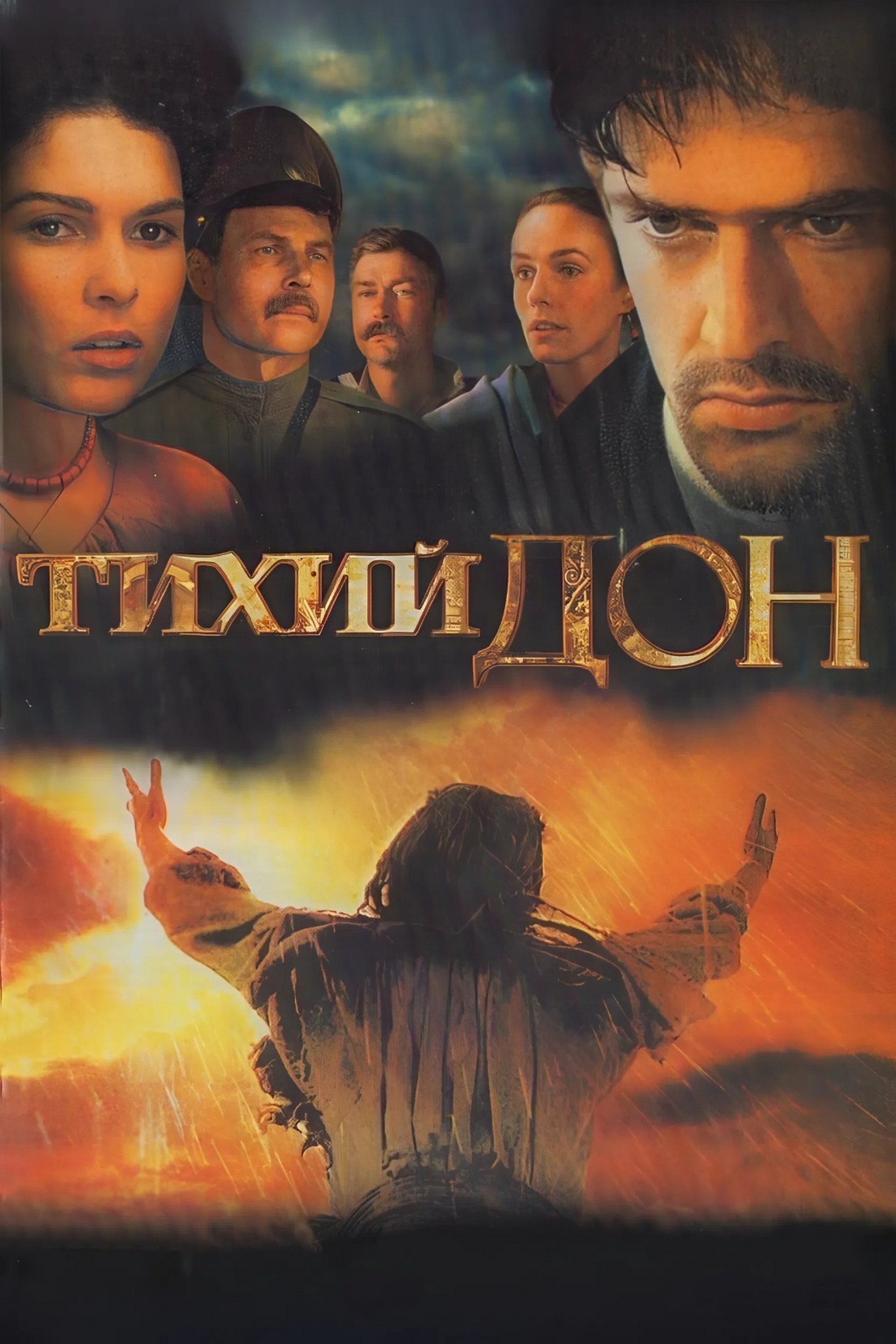 And Quiet Flows the Don(2006)
 The Colt(2005)
 They Fought for Their Country(1975)
 Smertnyy vrag(1972)
 And Quiet Flows the Don(1930)
 Diaries of the traveler(2024)
 Travel from Moscow to St. Petersburg on the ship Nikolai Karamzin(2020)
 Kak ukhodili kumiry(2005)as Self
 Ya byl sovetskim pisatelem(1996)as Self - writer
 Sergey Bondarchuk(1982)as Self

