Lyudmila Tselikovskaya was a Russian film and stage actress, and
unofficial sex symbol in the 1940s Soviet Union. She was loved by
general public, but was censored under the dictatorship of
Joseph Stalin.
She was born Lyudmila Vasilyevna Tselikovskaya on September 8, 1919, in
Astrakhan, Russia. Her father, Vasili Tselikovsky, was an orchestra
conductor, her mother was an opera singer. Young Tselikovskaya studied
piano at the Gnesin School of Music in Moscow, then, from 1937 to 1941
she studied acting at the Shchukin Theatrical School of the Vakhtangov
Theatre, graduating in 1941 as an actress.
From 1941 to 1992 Lyudmila Tselikovskaya was a member of the troupe at
Vakhtangov Theatre in Moscow. There her stage partners were such actors
as
Mikhail Ulyanov,
Ruben Simonov,
Boris Zakhava,
Mikhail Astangov,
Varvara Popova,
Vasiliy Lanovoy,
Irina Kupchenko,
Yuliya Borisova,
Lyudmila Maksakova,
Marianna Vertinskaya,
Nina Ruslanova,
Nikolai Plotnikov,
Yuriy Yakovlev,
Vladimir Etush,
Vyacheslav Shalevich,
Andrei Abrikosov,
Grigori Abrikosov,
Boris Babochkin,
Nikolai Gritsenko,
Nikolai Timofeyev, Evgeni
Fedorov,
Aleksandr Grave,
Vladimir Koval,
Viktor Zozulin,
Evgeniy Karelskikh,
Sergey Makovetskiy, and
Ruben Simonov, among others.
Tselikovskaya gave memorable performances in the classic Shakespeare's
plays, such as Juliet in 'Romeo and Juliet', and Beatrice in 'Mnogo
shuma is nichego' (aka.. Much Ado about Nothing).
At the beginning of her film career, Tselikovskaya gave a stellar
performance in
Ivan the Terrible, Part I (1944) by director
Sergei Eisenstein. However,
Joseph Stalin canceled her nomination for
Stalin's Prize, and as a consequence, Tselikovskaya did not have any
official support for the rest of her career. During the Second World
War Lyudmila Tselikovskaya entertained the Red Army troops at the
front-lines together with her husband, actor
Mikhail Zharov. However, after the war,
she and Zharov were censored by the Soviet officials, and both became
virtually unemployed.
In 1948 Tselikovskaya married Karo Alabyan, a prominent architect, but
soon he was falsely accused of anti-Soviet activity, was fired from all
government projects, became depressed, and later died of cancer. For
the next 15 years, Tselikovskaya lived in a civil union with director
Yuriy Lyubimov, and their home in Moscow
was a meeting place for such cultural figures as
Boris Pasternak, Petr Kapitsa,
Vladimir Vysotskiy, Fedor
Abramov,
Yevgeniy Yevtushenko, and
other Russian intellectuals. At the same time, Tselikovskaya did not
have new roles to play, she was ignored by official Soviet critics, and
was rarely mentioned in the Soviet press. However, she was still loved
by general public, and was eventually designated People's Actress of
Russia. She died of cancer on July 2, 1992, in Moscow, Russia.


 Repetitor(1987)as Kseniya Lvovna Zamyatina
 Neveroyatnoye pari, ili istinnoye proisshestviye, blagopoluchno zavershivsheyesya sto let nazad(1984)as Madam Brykovich
 Les(1980)as Gurmyzhskaya
 Odnokashniki(1978)as Sofiya Polovskaya
 Den-denskoy(1978)as Romanenko
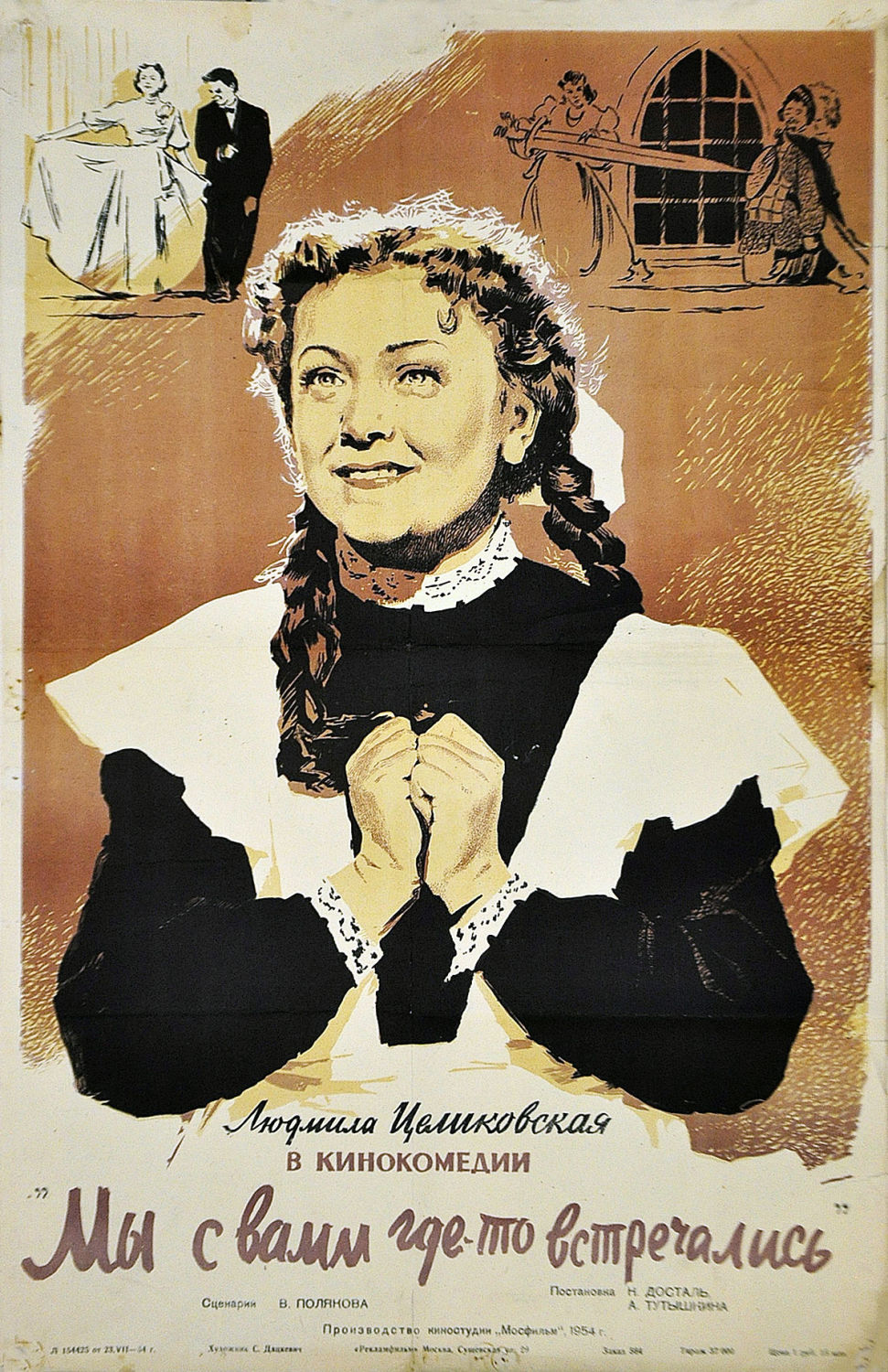 My s vami gde-to vstrechalis(1954)
 Les usines de Staline face aux armées d'Hitler(2024)as Self
 SSSR. Znak kachestva(2019)as Tatyana Korobova (segment 'Semya kak semya')
 Kak ukhodili kumiry(2005)as Self
 Legends of World Cinema(2004)as Self
 Chtoby pomnili(1993)as Self


