Born in Shanghai and Cambridge-educated, Terence Young began in the
industry as a scriptwriter. During the 1940s, he worked on a variety of
subjects, including the hugely popular wartime romance
Suicide Squadron (1941),
set to
Richard Addinsell's rousing
"Warsaw Concerto". His original story was devised while listening to a
concert in an army training camp. As it turned out, Young was soon
after involved in the war himself as a member of the Guards.
By the end of the decade, Young had graduated to directing. He made his
debut with the psychological melodrama
Corridor of Mirrors (1948),
starring
Eric Portman as a
reclusive art collector obsessed with reincarnation and murder. By the 1950s, Young helmed a number of international
co-productions which featured imported stars from Hollywood
(
Alan Ladd in
Paratrooper (1953);
Olivia de Havilland in
That Lady (1955);
Victor Mature in
Safari (1956),
Zarak (1956) and
Tank Force (1958)). These
films were made by Warwick, an independent production company created
jointly by
Irwin Allen and future
James Bond producer
Albert R. Broccoli, and released
through Columbia. Production values were often quite high, though
scripts were of variable quality. "Safari", for instance, looked great,
shot in Technicolor and CinemaScope on location in Africa, which partly
compensated for the trite storyline.
Having acquired the rights to all available James Bond novels from
Ian Fleming, producers
Harry Saltzman and Albert Broccoli
secured the necessary funding ($1,250,000) from United Artists and
hired Young to direct the initial Bond entry,
Dr. No (1962). The success of this picture got him
re-hired to direct two subsequent Bond films,
From Russia with Love (1963)
(Young's own personal favorite) and
Thunderball (1965). Young had
acquired a solid reputation as a master of action subjects, and all
three films move at a cracking pace. Exotic locales provide the
background for a seamless mix of technical wizardry, sex, violence and
tongue-in-cheek (sometimes campy) dialogue. Unfortunately, these films
also marked the high point of Young's career, though he did direct
another eerily effective psychological thriller,
Wait Until Dark (1967), much in
the vein of
Alfred Hitchcock.
Among a brace of forgettable European co-productions, only two other
films stand out: the bawdy, highly entertaining all-star period comedy
The Amorous Adventures of Moll Flanders (1965)
and an intriguing expose of the inner workings--and dark beginnings--of
the Cosa Nostra (based on an actual informant's testimony), entitled
The Valachi Papers (1972).
After that, Young's output became more patchy and his later career
suffered as a result of two disastrous projects: first, the Korean War
epic
Inchon (1981), with
Laurence Olivier badly miscast as Gen.
Douglas MacArthur. The
enterprise was reputedly financed by the Rev.
Sun Myung Moon's organization--aka the
"Moonies"--to the tune of $40 million. Film critic
Vincent Canby in the New York Times
(September 17, 1982) referred to the picture as "hysterical" and
"foolish", "the most expensive B-movie ever made". The second flop, a
financially troubled production, was the predictably plotted spy
thriller
The Jigsaw Man (1983).
Completed in 1982, the film was held back and not released until two
years later. Young directed just one more film after that and left the
industry in 1988. However, according to his daughter, he was working on
a documentary in Cannes at the time of his death in September 1994.
Though he went on record in 1966, asserting that he had grown rather
tired of the Bond franchise, it is, nonetheless, that for which we will
ultimately remember him.

 Run for Your Life(1988)
 The Jigsaw Man(1983)
 Inchon(1981)
 Al-ayyam al-tawila(1980)
 Bloodline(1979)
 Foxbat(1977)
 War Goddess(1973)
 The Christmas Tree(1969)
 Mayerling(1968)
 Atout coeur à Tokyo pour OSS 117(1966)
 From Russia with Love(1963)as Writer of 'From Russia with Love' on Photo
 Where Is Parsifal?(1984)
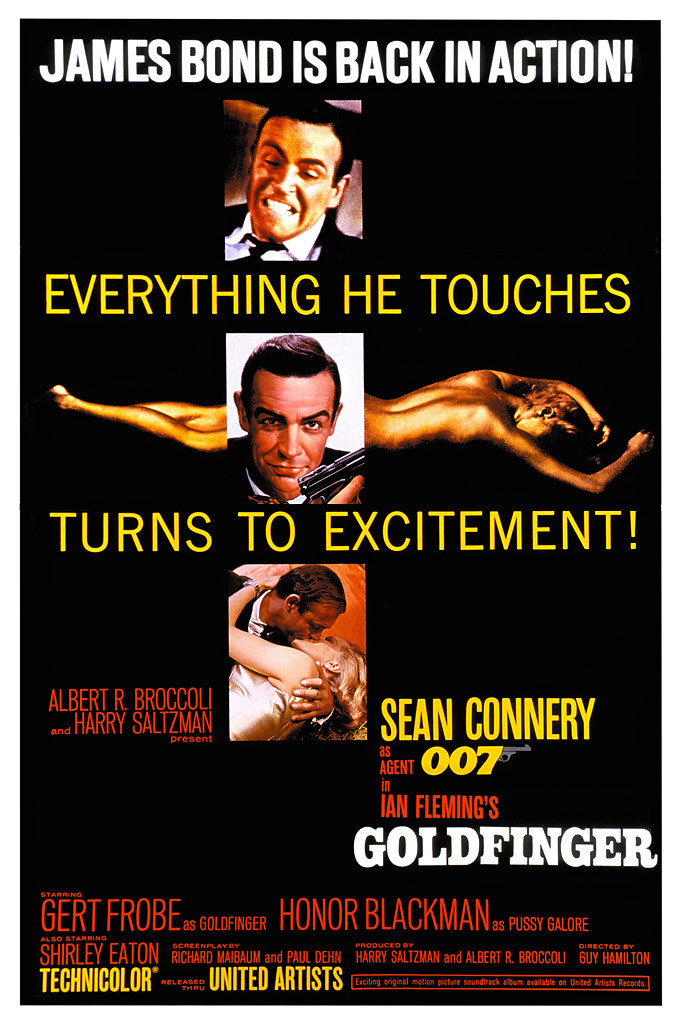 Goldfinger(1964)
 Birds, Orphans and Fools(1969)
 ECU(2025)
 Frankenpimp(2009)
 The Bad Lord Byron(1949)
 Inside 'Dr. No'(2000)as Self
 The James Bond Story(1999)as Self - Interviewee
 Le divan(1987)as Self
 30 Years of James Bond(1992)as Self
 Hollywood Insider(2018)as Self
 Everything or Nothing(2012)as Self
 Biography(1987)as Self


