Georgi Zhzhyonov was a popular Russian actor who survived 18 years of
imprisonment under the dictatorship of
Joseph Stalin.
He was born Georgi Stepanovich Zhzhonov on March 22, 1915, in St.
Petersburg (then Petrograd), Russia. He was the seventh of ten children
of Stepan Philippovich Zhzhonov and Maria Fedorovna Shchelkina. In 1921
his father was arrested and imprisoned for opposition to the
communists. The Zhzhonov family lived on Bolshoi Prospekt of the
Vasilevsky Ostrov in the historic center of St. Petersburg, near the
"Petrogradets" stadium sports center. There young Zhzhonov took arduous
physical training, specializing in acrobatics.
In 1930, Zhzhonov graduated from a secondary school with advanced
course of mathematics. He borrowed his elder brother's ID in order to
pass the admission to Acrobatic class at the Leningrad Circus School,
where he was admitted as "Boris" Zhzhonov and studied for two years. He
was forgiven for his innocent forgery, because of his excellence in
acrobatics. He was noticed by a cinematographer during his acrobatic
performances at the Leningrad Circus and was cast for the leading role
as Pavel Vetrov in 'Oshibka Geroya' (1932), a silent film directed by
Eduard Ioganson, where his partner was
Yefim Kopelyan. From 1932-1935, Zhzhonov
studied under
Sergey Gerasimov at the
Leningrad Theater and Film Institute, where his classmate was
Arkady Raykin. Zhzhonov continued his film
career in the classic film
Chapaev (1934), where he played a cameo
role alongside
Boris Babochkin. Then he
worked again with director
Eduard Ioganson in Nasledny prints
respubliki (1934). In 1935 Zhzhonov graduated from the class of
Sergey Gerasimov and his film career
looked good.
At that time, after the popular Leningrad governor, Sergei Kirov, was
murdered,
Joseph Stalin started
extermination of Russian intellectuals. Zhzhenov's elder brother,
Boris, was falsely accused of "anti-Soviet activity", and was executed
in prison. The entire family of Zhzhonovs (father, mother, five sisters
and two surviving brothers) were exiled to Siberian part of Kazakhstan.
Georgi Zhzhonov refused to obey. At age 20 he was already recognized as
a brilliant actor, and his film career was at stake. The Lenfilm Studio
petitioned to postpone his exile, because he was cast by
Sergey Gerasimov for a supporting role
in 'Komsomolsk' (1938). His exile sentence was postponed and he joined
the cast and crew on a train to the filming location at the city of
Komsomolsk-on Amur on the Pacific Far East. On the train he met an
American diplomat, who treated Zhzhonov to a taste of American
cigarettes and they had a friendly conversation. That was enough for
the Soviet secret police to arrest him on false accusations of spying
for America.
Zhzhonov was forcefully separated from his wife, young actress
Yevgeniya Golynchik, and was taken
to the KGB prison in Leningrad. There he was tortured, humiliated,
blackmailed and exiled to Kolyma in Siberia from 1938 to 1945. In 1945
he was allowed to work in Magadan Zapolyarny Drama Theatre in Siberia.
In 1947 he came to Moscow, but he was banned from living in the Soviet
Capital. He was arrested again on false accusations and was exiled to
Norilsk in Northern Siberia. There he worked at the Zapolyarny Drama
Theatre together with his friend
Innokentiy Smoktunovskiy. Zhzhonov
lived in exile until the death of
Joseph Stalin.
In 1955, after 18 years of imprisonment and exile, Georgi Zhzhonov was
allowed to return to his home town of Leningrad. There he was cleared
of all previous charges of "anti-Soviet activity and spying for
America" and was allowed to work as an actor in Leningrad. He also
received official clearance for work in film. He returned to acting at
the Theatre of Lensoveta and other theatres in Leningrad during
1955-1968.
Zhzhonov became known after a role in 'Beregis avtomobilya' (Watch out
for Automobile 1966) by director
Eldar Ryazanov. From 1968-2005 he lived
in Moscow and worked on stage and in film. He was best known for the
leading role as Western spy "Resident" in the eponymous film-trilogy
from director
Venyamin Dorman, and also
for the leading role in 'Ekipazh' (1980) from director
Aleksandr Mitta. Zhzhonov himself
regarded his work with actor-director
Mikhail Kozakov in the TV movie 'Vsya
korolevskaya rat' (All the King's Men 1972). The first episode was
already filmed with
Pavel Luspekayev in
the leading role as Senator Stark, but Luspekayev suddenly died during
filming. In a fierce competition with other renown actors the role was
won by Zhzhonov. His masterful acting in the leading role as Senator
Stark was praised by the author
Robert Penn Warren.
Georgi Zhzhonov wrote an autobiographical story of his Gulag
prison-camp experience, which was praised by
Aleksandr Solzhenitsyn and was
published in Russia. He was awarded the State Prize of the USSR, and
was honored with the title of the People's Artist of the USSR. He also
received the 'Nika Award' for lifelong career.
Zhzhonov spent his 90th birthday on stage, acting at the Russian Army
Theatre. Later that day, he was invited to the Kremlin for reception of
the highest civilian decoration of Russia. During a conversation that
followed, President Putin admitted that Zhzhonov's popular film roles
had prompted him to become an intelligence officer. Zhzhonov replied
with dark humor: "Just don't arrest me again."
Georgi Zhzhonov died on December 8, 2005, and was laid to rest in the
Novodevichy Cemetery in Moscow, Russia.

 Nezrimyy puteshestvennik(1999)
 Zagon(1988)as Menshikov
 Ivan Veliky(1987)as ded Ivan - otets Ivana Vladyko
 Vremya synovey(1987)as Sergey Uzelkov
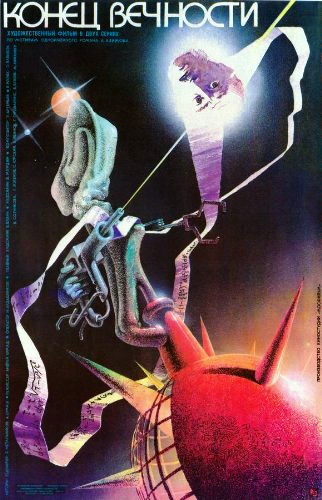 Konets vechnosti(1987)as Laban Twissel
 The Red Tent(1969)
 Novodevichy cemetery(2019)
 Georgy Zhzhyonov. Russky krest(2005)as Self
 Nikolay II: krug zhizni(1998)as Nikolay II
 Vremya(1968)as Andrey Timchenko (segment: Ekipazh)
 Gulag: The History(2019)as Self
 Kak ukhodili kumiry(2005)as Self
 Voyage to the Planet of Prehistoric Women(1968)as Astronaut Hans Walters
 Voyage to the Prehistoric Planet(1965)as Hans Walters - Sirius


