Vincent Willem van Gogh was born on March 30, 1853, in Zundert,
Netherlands. His father, named Theodorus van Gogh, was a Protestant
minister. His mother, named Anna Cornelia Carbentus, was a daughter of
the "book-binder to the King" Willem Carbentus; who had bound the first
Consitution of Holland. Vincent Van Gogh was given the name of his
elder brother, who had died at birth a year before Van Gogh was born.
He had two junior brothers and three sisters, and was strongly attached
to his brother Theo.
Young Van Gogh was brought up in a religious and strict atmosphere. He
was severely punished by his grandmother at one time. He had a very
uncontrollable temper, was highly emotional, and lacked
self-confidence. From the age of 7 to 11 he was taught at home by a
governess. Then from the age of 11 to 15 he was sent to boarding
schools in the Netherlands. His first art teacher was Constantijn
Huysmans, a professional artist, who taught the young Van Gogh basic
drawing and composition. From 1869-1873 Van Gogh worked for an
established art dealer, Goupil & Cie, in the Hague. Then he worked in
London and Paris until 1876, when he was fired for showing resentment
to the customers. Van Gogh went to England as a minister's assistant.
Then he studied theology at the University of Amsterdam for one year,
but gave up. He tried to follow his father's profession and become a
preacher in Belgium, but was dismissed after a year for "underminig the
dignity of the priesthood."
He studied at the Royal Academy of Art in Brussels for six months in
1880 and 1881. In the summer of 1881 Van Gogh fell in love with his
widowed cousin, Kee Vos, but was cruelly rejected by her. He became
upset and resentful. This led to a violent quarrel with his father on
Christmas, and he moved in with an alcoholic prostitute for a year. In
1884 Van Gogh had a romance with a neighbor's daughter, who shared his
interest in art, but their marriage was opposed by both families. This
and the death of his father in March of 1885 caused depression. At that
time Van Gogh made his first major work, "The Potato Eaters". In
September of 1885 he was accused of making one of his sitters, a young
peasant girl, pregnant and was ostracized by the local Church. He moved
to Antwerp, where he studied color theory and painting at the Antwerpen
School of Arts, and matriculated in January of 1886. While he was away,
his mother and sister moved. They left behind almost all of his
paintings, of which 70 were bought by a junk dealer and some were
burned.
From March 1886 to February 1888, Van Gogh lived in Paris. There he met
the Impressionists:
Claude Monet,
Pierre-Auguste Renoir,
Edgar Degas, Alfred Sisley, Paul Signac,
Georges Seurat, and brothers Lucien and
Camille Pissarro. The Impressionist's use of light and color inspired
Van Gogh on updating his own palette. During the Paris years, his color
scheme became brighter and lighter. His use of complementary colors in
proximity produced remarkable decorative effects. He wrote: "I want to
use colours that complement each other, that cause each other to shine
brilliantly, that complete each other like a man and a woman." Van Gogh
also adopted some ideas of pointillism, but developed his own technique
with stronger brush-strokes, sharp composition, and his own color
scheme using complementary colors. He created about 200 oil paintings
during his two years in Paris.
In February of 1888 Van Gogh moved to Arles with a plan to found an art
colony. His friend
Paul Gauguin joined in
October. Van Gogh presented him several paintings of sunflowers, but
their cooperation lasted only for two months. Their arguments about art
and life were exacerbated by drinking and rivalry for prostitutes. Van
Gogh's mental state was alternating between fits of depression and
lucidity. At times, his madness led to aggressive actions. In December
of 1888 he attacked
Paul Gauguin with an
open razor, was stopped, but eventually cut part of his ear off and
gave it to a prostitute.
Paul Gauguin sent
a note to his brother Theo and left forever. Theo immediately came to
help. Van Gogh was sent to the state mental hospital of St. Paul in
Saint Remy de Provence. There he lived for a year and made some of his
best works: "Starry Night", "Vincent's Bedroom", and several paintings
of Irises.
Van Gogh was released in May of 1890 and moved to live in
Auvers-sur-Oise under supervision of Dr. Gachet. His health improved
enough to give him energy for the most intensive work marathon. In just
two months there he painted ninety excellent works. This included
portraits of Dr. Gachet, landscapes, still-lives, and "Wheat Field with
Crows". In a state of depression he went out into the wheat field and
shot himself in the chest on July 27, 1890. Fatally wounded, Van Gogh
died two days later in the arms of his brother Theo. He was laid to
rest at the cemetery of Auvers-sur-Oise.
Van Gogh's disobedience drove his creativity towards new horizons.
Although categorized as a Post-impressionist, Van Gogh pioneered the
style of Expressionism and had a very important influence on 20th
century art. He influenced many artists and art movements, such as
Henri Matisse and the French Fauves,
Ernest Ludwig Kirchner and German
Expressionists, as well as
Francis Bacon
and other artists. Van Gogh was been the topic of several biographical
films. He was played most memorably by
Kirk Douglas in
Lust for Life (1956) and by
Tim Roth in
Vincent & Theo (1990). The highly
popular song "Vincent" by
Don McLean
was a tribute to Van Gogh.

 La galerie France 5(2012)
 Van Gogh autoportrait(2011)
 Painted with Words(2010)
 The Irises(1991)
 Secretly Sweetly S3 Vincent Van Gogh(2024)
 The Thomas Crown Affair(1999)
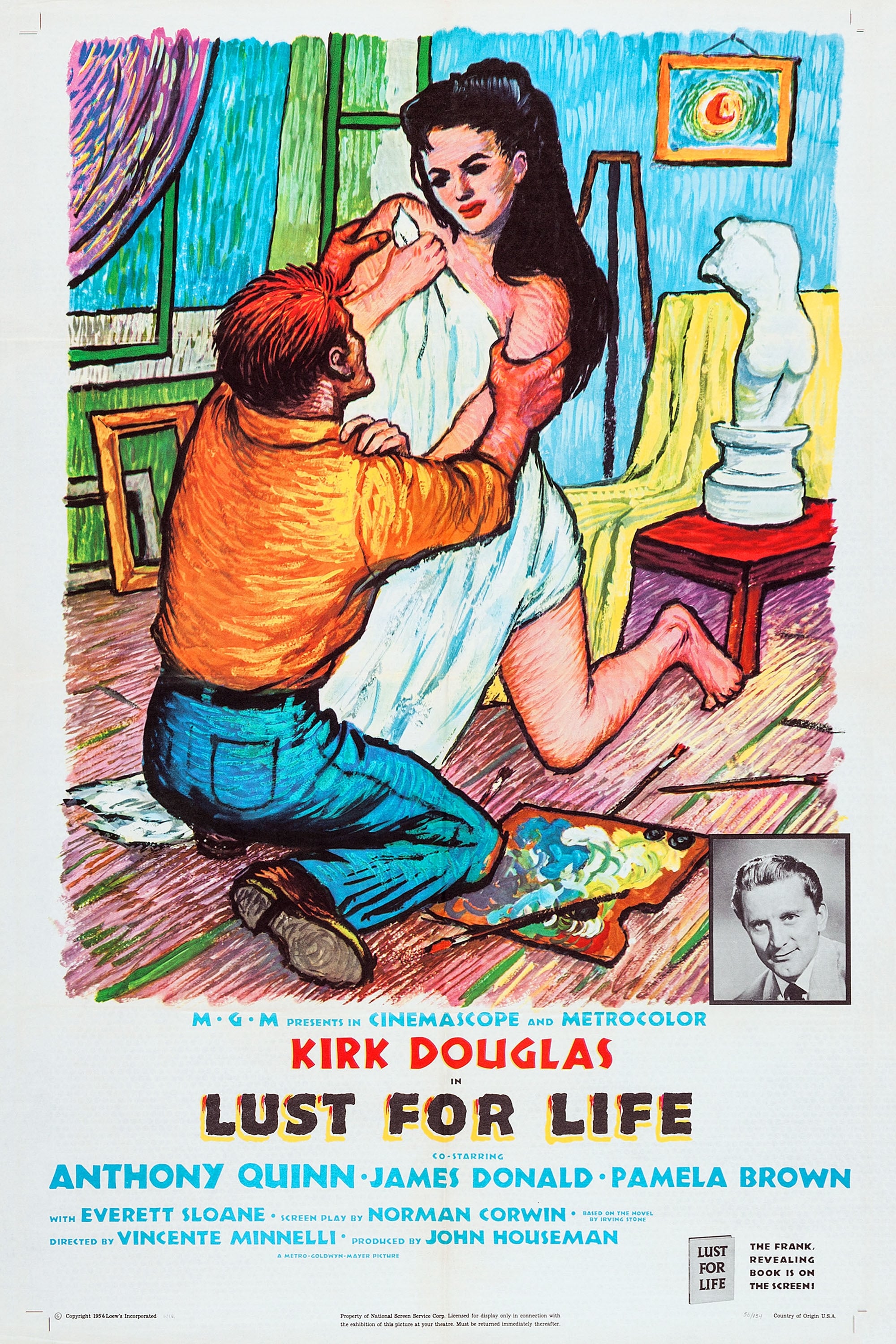 Lust for Life(1956)
 The Maestro: King of the Cowboy Artists(1995)
 Silent Room(2023)
 A Swan Story(2023)
 Vincent van Gogh's Footsteps(2021)
 Forest Bathing: Friends W/Benefits(2017)
 Art on the BBC(2018)as Self
 I Vortici di Van Gogh(2021)as Self
 Hollywood Insider(2018)as Self
 Film Önü / Arkasi(2019)as Self
 Keeping It Real Art Critics(2016)as Self


