Eugene Henri Paul Gauguin was born on June 7, 1848, in Paris, France.
His father, Clovis Gaughin, was a Republican editor who died on his way
to Peru while escaping from Louis Napoleon. His widowed mother was a
Peruvian Creole daughter of writer Flora Tristan. Young Gauguin spent
early childhood in Lima, Peru, until 1855, then studied in Orleans,
France. He joined the Merchant Marine in 1865 and spent the next six
years sailing between France and South America, then spent a hitch in
the French navy. In 1871 he returned to France, settled in Paris and
became a stockbroker.
In 1874 Gauguin saw the first Impressionist exhibition, which gave him
his desire to become an artist. Enchanted with art, he spent some
17,000 francs on paintings by
Claude Monet, Camille Pissarro,
Pierre-Auguste Renoir and
other impressionists. Gauguin discovered art as a way to escape from
the pressures of civilization. He met Camille Pissarro and Paul Cezanne in
1874, and joined them for painting on weekends and holidays. His debut
in the Salon took place in 1876. He also participated in the
Impressionist exhibitions in 1879, 1880 and 1882. By 1884 he became a
full-time artist, partly because the bank that employed him had
difficulties. Paris became too expensive and Gauguin moved with his
wife and five children to Rouen, then to Copenhagen, Denmark, and then
back to Paris. In 1885 he and his wife separated and she took the
children with her to her family. Gauguin went into depression and at
one time attempted suicide.
He met
Vincent van Gogh in Paris in 1886 and they became friends. Van Gogh's
brother Theo was also Gauguin's art dealer. In 1888 he received an
invitation from Vincent and joined him in October of that year in
Arles. There Van Gogh presented him several paintings of sunflowers,
but their cooperation lasted only for two months. Their arguments about
art and life were exacerbated by drinking and rivalry for prostitutes.
Van Gogh's mental state was alternating between fits of depression and
lucidity. At times his madness led to aggressive actions. In December
of 1888 Van Gogh attacked Gauguin with an open razor, was stopped, but
eventually cut part of his own ear off and gave it to a prostitute.
Gauguin sent a note to Van Gogh's brother Theo and left forever.
In 1891 Gauguin organized an exhibition to finance his project of
living and working in places where he could "live with ecstasy,
calmness and art." His paintings were bought by
Edgar Degas and others, and
the proceeds amounted to 10,000 francs. He started his flight from the
trappings of civilization by becoming a full-time artist and this time
he sailed to the tropics for good. Gauguin left behind "everything that
is artificial and conventional." He settled in Tahiti and later in the
Marquesas Islands. There he was accepted by the native community and
adopted their traditional lifestyle. He fathered a son by his Tahitian
model Pau'ura and a daughter with his Tahitian model Vaa'oho. From 1893
to 1895 he made farewell visits to Paris and Copenhagen. There he
brought some of his Polynesian-inspired works to show.
Gauguin gradually parted from Impressionism. He discovered the
primitive art of Polynesia and was influenced by it. He was calling his
new style "synthetic symbolism." Gauguin transformed his art to radical
simplifications of composition by giving his paintings an ornamental
character. His "Arearea" (Joyousness 1892), "Nave", "Nave Moe"
(Miraculous Source 1894) and other paintings made in Tahiti are sincere
depictions of an untamed nature with people being an organic part of
it. His largest work was painted in Tahiti, the philosophical and
highly decorative "D'ou venons nous? Que sommes-nous? Ou allons-nous?"
(Where Do We Come From? What Are We? Where Are We Going? 1897), now in
the permanent collection of the Boston Museum of Fine Art.
Paul Gauguin moved around several islands of Polynesia and finally
settled in Atuona, Marqueses. He was fined by the colonial
administration, had problems with the Catholic church and was sentenced
to three months in prison. Before he could begin his sentence, however,
he died on May 8, 1903, and was laid to rest in Calvary Cemetery,
Atuona, Hiva'Oa, Marquesas Islands, French Polynesia.
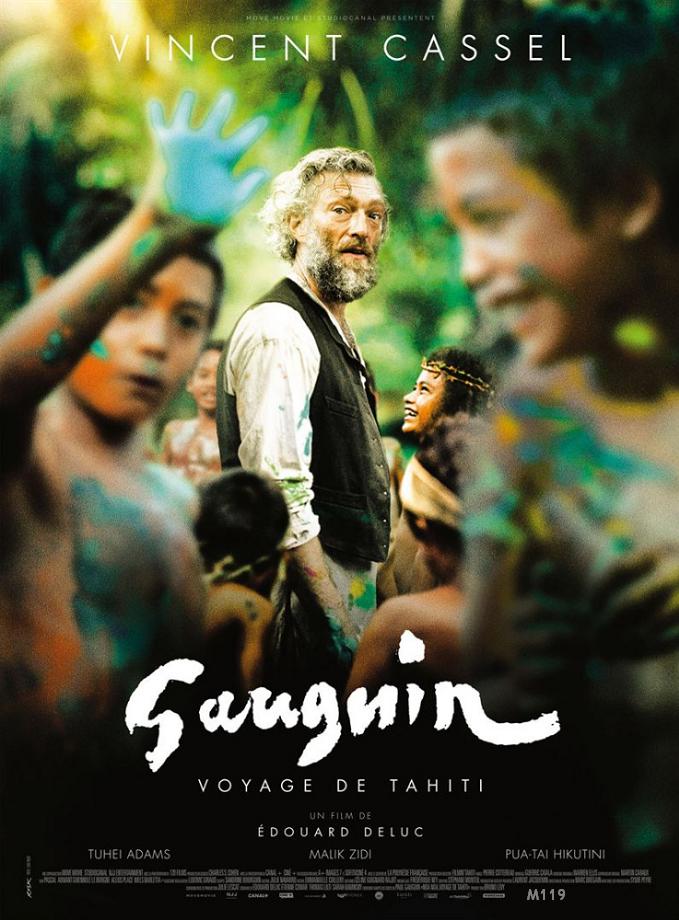 Gauguin: Voyage to Tahiti(2017)
 La galerie France 5(2012)
 Gauguin à Tahiti et aux Marquises(2010)
 Vincent van Gogh(1988)
 Gauguin(1949)
 Five Star Murder(2023)
 Yksitoista ihmisen kuvaa(2012)
 Silent Room(2023)
 Moscow we will lose(2019)
 Bir Resim Bir Hikaye(2019)as Self - Subject
 Kulturzeit(1995)as Self
 Der weiße Blick - Expressionismus und Kolonialismus(2021)as Self
 Film Önü / Arkasi(2019)as Self