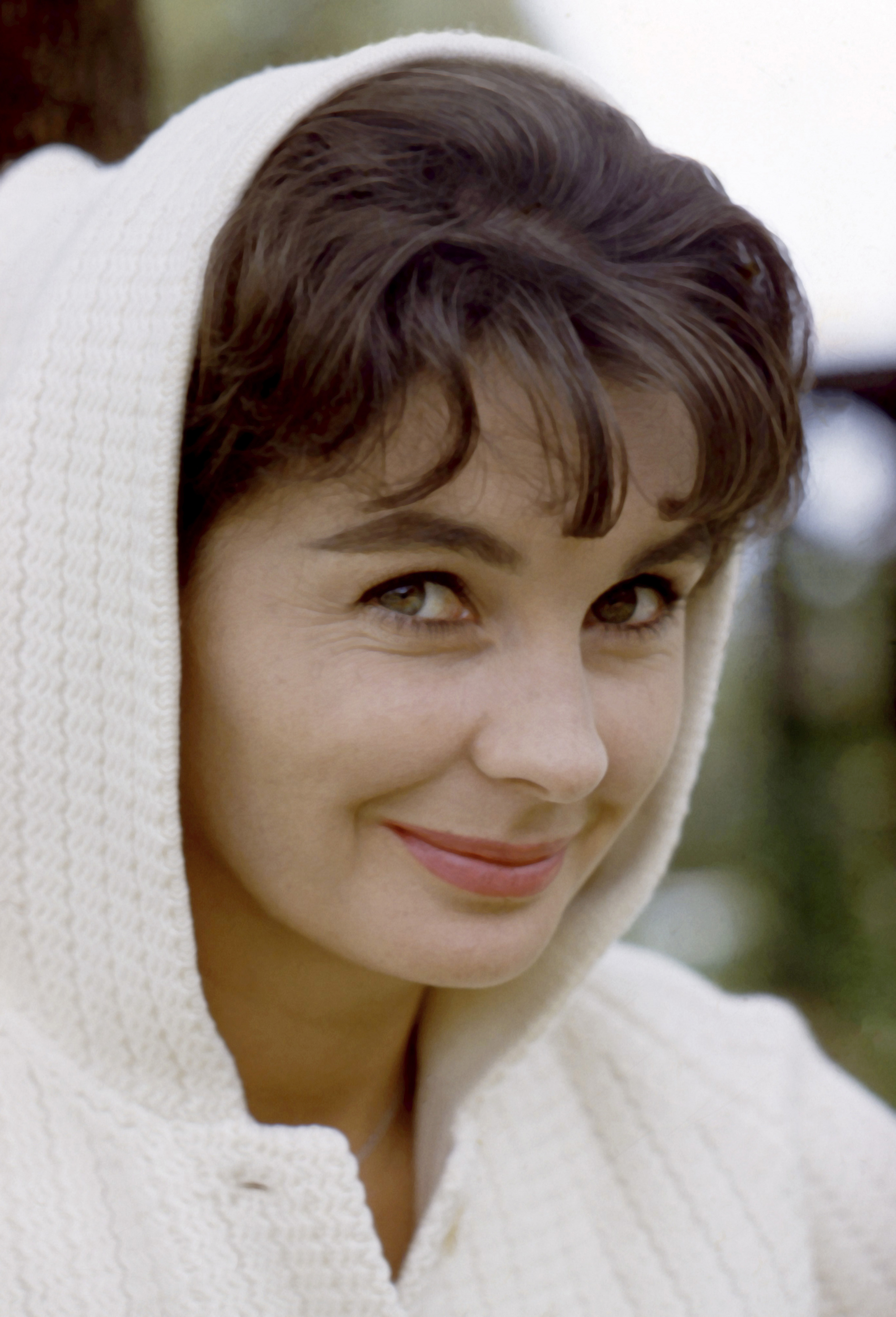
Demure British beauty Jean Simmons was born January 31, 1929, in Crouch End, London. As a 14-year-old dance student, she was plucked from her school to play
Margaret Lockwood's precocious sister in
Give Us the Moon (1944). She had a small part as a harpist in the high-profile
Caesar and Cleopatra (1945), produced by
Gabriel Pascal, starring
Vivien Leigh, and co-starring her future husband
Stewart Granger. Pascal saw potential in Simmons, and in 1945 he signed her to a seven-year contract to the
J. Arthur Rank Organization, and she went on to make a name for herself in such major British productions as
Great Expectations (1946) (as the spoiled, selfish Estella),
Black Narcissus (1947) (as a sultry native beauty),
Hamlet (1948) (playing Ophelia to
Laurence Olivier's great Dane and earning a Best Supporting Actress Oscar nomination),
The Blue Lagoon (1949) and
So Long at the Fair (1950), among others.
In 1950, she married Stewart Granger, and that same year, she moved to Hollywood. While Granger was signed to Metro-Goldwyn-Mayer, Rank sold her contract to
Howard Hughes, who then owned RKO Pictures. Hughes was eager to start a sexual relationship with Simmons, but Granger put a stop to his advances. Her first Hollywood film was
Androcles and the Lion (1952), produced by Pascal and co-starring
Victor Mature. It was followed by
Angel Face (1952), directed by
Otto Preminger with
Robert Mitchum. To further punish Simmons and Granger, Hughes refused to lend her to Paramount, where
William Wyler wanted to cast her in the female lead for his film
Roman Holiday (1953); the role made a star of
Audrey Hepburn. A court case freed Simmons from the contract with Hughes in 1952. They settled out of court; part of the arrangement was that Simmons would do one more film for no additional money. Simmons also agreed to make three more movies under the auspices of RKO, but not actually at that studio - she would be lent out. MGM cast her in the lead of
Young Bess (1953) playing a young Queen Elizabeth I with Granger. She went back to RKO to do the extra film under the settlement with Hughes, titled
Affair with a Stranger (1953) with Mature; it flopped.
Simmons went over to 20th Century Fox to play the female lead in
The Robe (1953), the first CinemaScope movie and an enormous financial success. Less popular was
The Actress (1953) at MGM alongside
Spencer Tracy, despite superb reviews; it was one of her personal favorites. Fox asked Simmons back for
The Egyptian (1954), another epic, but it was not especially popular. She had the lead in Columbia's
A Bullet Is Waiting (1954). More popular with moviegoers was
Désirée (1954), where Simmons played Désirée Clary to
Marlon Brando's Napoleon Bonaparte. Simmons and Granger returned to England to make the thriller
Footsteps in the Fog (1955). She then starred in the musical
Guys and Dolls (1955) with Brando and
Frank Sinatra; she used her own singing voice and earned her first Golden Globe Award. Simmons played the title role in
Hilda Crane (1956) at Fox, a commercial failure. So, too, were
This Could Be the Night (1957) and
Until They Sail (1957), both at MGM. Simmons had a big success, though, in
The Big Country (1958), directed by Wyler. She starred in
Home Before Dark (1958) at Warner Bros. and
This Earth Is Mine (1959) with
Rock Hudson at Universal.
Simmons divorced Granger in 1960 and almost immediately married writer-director
Richard Brooks, who cast her as Sister Sharon opposite
Burt Lancaster in
Elmer Gantry (1960), a memorable adaptation of the
Sinclair Lewis novel. That same year, she co-starred with
Kirk Douglas in
Stanley Kubrick's
Spartacus (1960) and played a would-be homewrecker opposite
Cary Grant in
The Grass Is Greener (1960).
Off the screen for a few years, Jean captivated moviegoers with a brilliant performance as the mother in
All the Way Home (1963), a literate, tasteful adaptation of
James Agee's "A Death in the Family". However, after that, she found quality projects somewhat harder to come by, and took work in
Life at the Top (1965),
Mister Buddwing (1966),
Divorce American Style (1967),
Rough Night in Jericho (1967),
The Happy Ending (1969) (a Richard Brooks film for which she was again Oscar-nominated, this time as Best Actress).
Jean continued making films well into the 1970s. In the 1980s, she appeared mainly in television miniseries, such as
North & South: Book 1, North & South (1985) and
The Thorn Birds (1983). She made a comeback to films in 1995 in
How to Make an American Quilt (1995) co-starring
Winona Ryder and
Anne Bancroft, and most recently voiced the elderly Sophie in the English version of
Hayao Miyazaki's
Howl's Moving Castle (2004). She now resided in Santa Monica, California, with her dog, Mr. Gates, and her two cats, Adisson and Megan. Jean Simmons died of lung cancer on January 22, 2010, nine days before her 81st birthday.
 Shadows in the Sun(2009)as Hannah
 Thru the Moebius Strip(2005)as Shepway
 Rosamunde Pilcher(1993)as Countess Lucinda Rhives
 Winter Solstice(2003)as Countess Lucinda Rhives
 Final Fantasy: The Spirits Within(2001)as Council Member #2
 Howl's Moving Castle(2004)
 Guys and Dolls(1955)
 The Actress(1953)
 Johnny in the Clouds(1945)
 The 100 Greatest Family Films(2005)as Self
 American Masters(1985)as Self
 Compression(1995)as Self
 Hollywood So French!(2023)as Self
 Robert Mitchum, le mauvais garçon d'Hollywood(2018)as Self
 The Best of Hollywood(1999)as Self - Interviewee
 Trumbo(2015)as Varinia


