George Pal was born on February 1, 1908, in Cegled, Austria-Hungary.
Later, when he was still a child, his stage-entertainer parents
divorced, and he was raised by his grandparents.
In 1928, Pal graduated from the Budapest Academy of Arts with a degree
in Architecture and highly developed drawing skills. There were no
opportunities for an Architect when he left the University, so, putting
his other talents to work, he found employment at Hunnia Films in
Budapest. Later on, through his films, Pal became an architect of
worlds, but first...
At Hunnia, Pal drew lobby posters and created embellished titles for
silent movies. He also quickly learned the craft of motion picture
cartooning.
In 1930, George married Elisabeth Josepha (Zsoka) Grandjean, with whom
he later had two sons, David (born, 1937) and Peter (born, 1941).
Seeking work with better pay, the young couple moved to Berlin, a
center for film innovation. Pal's talents were soon noticed.
From 1931-1932, Pal worked at UFA Studios in Berlin where he became
head of the cartoon department. Then, he set up his own film studio
elsewhere in Berlin. His credentials attracted orders from companies
for animated advertising. Instead of the cartoon approach, he developed
his own take on making inanimate objects move, even dance, using the
still evolving art of stop-motion photography. Advertisements
featuring, for instance, Overstolz cigarettes, outfitted with faces,
arms, and legs, were shown on theater screens strutting and singing as
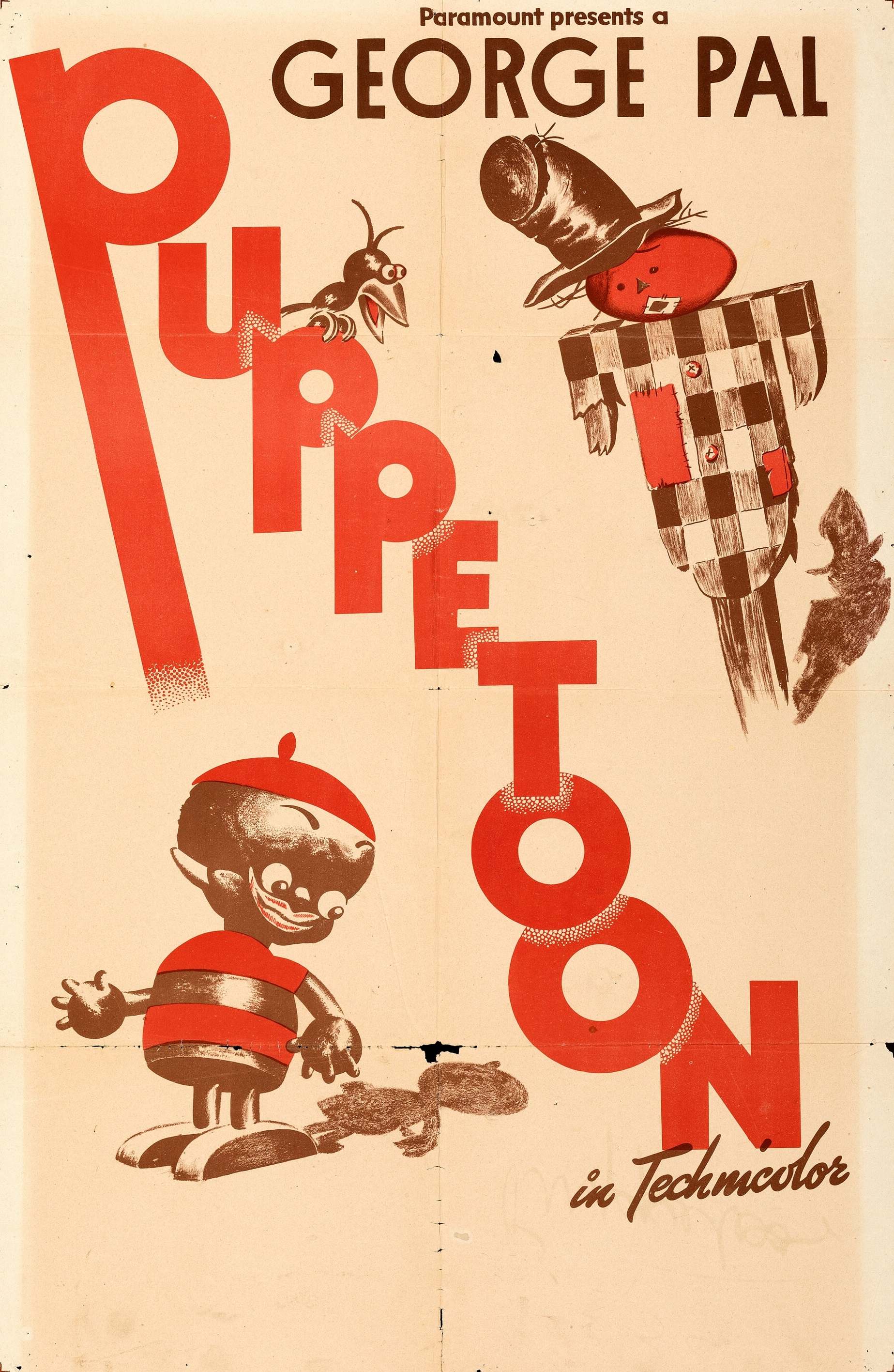
if drawn by a cartoonist. These "puppets" without strings would later
evolve into animated characters made of wood who would have names and
star in their own films.
When the Nazi regime installed itself in Germany, George and Zsoka left
for Prague for a short time. Then it was on to Paris where they
received an invitation from Sies Neuman, head of Philips Radio's
advertising, to move to Eindhoven, Noord-Brabant, Netherlands, and work
there. Before long, he had his own studio and made commercials for
Dutch, English, and American firms.
It was in Eindhoven that George and American film maker, Dave Bader,
invented a name for the three-dimensional cartoons that George was also
now producing: "Puppetoons." George made many films in Holland,
including "The Ship of the Ether." He changed his last name from
Marczincsak to Pal, and, in 1937, George and Zsoka's first son, David,
was born.
During the 1930s, George and Zsoka applied for an American emigration
visa, only to be told each time that the small Hungarian quota was
filled. Then, in 1939, the American consulate granted a visa for them
and their young son to leave for New York.
First, Pal made a solo trip to New York. Not long after arriving,
Columbia University offered him a lectureship on the process of making
stop-motion films. Coincidentally, Barney Baliban, the president of
Paramount Pictures' New York office, saw one of Pal's Puppetoon films
at a party. He was so impressed by it that he contacted Pal and offered
him a contract to make them for Paramount, either in New York or at
their animation studio in Florida.
Pal returned to Holland and made arrangements for his family to leave
Europe and move to America. Then, Frank Freeman, the President of
Paramount Studios in Hollywood offered him a studio of his own and a
staff of 25 film makers. The Pals arrived in New York early in 1940 and
were soon settled in Beverly Hills, California.
In 1941, George and Zsoka's second son, Peter, was born.
From 1941 to 1947, Pal created more than 40 Puppetoon films, and
received a special Academy Award in 1943. His studio staffers included
Willis H. O'Brien,
Ray Harryhausen,
Wah Chang, and
Gene Warren. He was also close friends with
animation producer,
Walter Lantz, as well as film pioneer,
Walt Disney.
From 1948 to 1949, he began work on his first full-length motion
pictures that combined live action with special photographic and sound
effects. In the 1950s and 1960s, six of his films received Academy
Awards. He worked with many gifted talents, including: director
Byron Haskin; writers
Robert A. Heinlein,
Barré Lyndon, and
David Duncan; cinematographers
George Barnes, and
Paul Vogel; visual-effects masters
Gordon Jennings and his crew at
Paramount, plus
A. Arnold Gillespie,
Wah Chang, and
Gene Warren at MGM.
Pal also worked with sound-effects wizards
Gene Garvin,
Harry Lindgren,
Franklin Milton,
and
Van Allen James; art directors
Albert Nozaki,
Hal Pereira,
Ernst Fegté, and
William Ferrari; film
editors
Everett Douglas and
George Tomasini; composers
Leith Stevens and
Russell Garcia; space
artist
Chesley Bonestell; many animation craftsmen, including his son,
David Pal,
(who brought the elves to life in "The Wonderful World of the Brothers
Grimm") and
Don Sahlin who would later go on to design the original Muppet
characters; plus countless actors and actresses, many of whom are
remembered to this day.
Throughout the 1970s, Pal worked on several film proposals, but only
one was distributed. He passed away on May 2, 1980 while working on
"The Voyage of the Berg" for AIP Filmways. It was never finished, but
his other films endure.

 7 Faces of Dr. Lao(1964)
 The Wonderful World of the Brothers Grimm(1962)
 Atlantis: The Lost Continent(1961)
 The Time Machine(1960)
 Doc Savage: The Man of Bronze(1975)
 Curiosity Shop(1971)
 Together in the Weather(1946)
 My Man Jasper(1945)
 Jasper's Paradise(1944)
 The War of the Worlds(1953)as Bum #1 Listening to Radio
 The Power(1968)
 John Henry and the Inky-Poo(1946)
 Jasper and the Beanstalk(1945)
 And to Think That I Saw It on Mulberry Street(1944)
 A Hatful of Dreams(1944)
 The 500 Hats of Bartholomew Cubbins(1943)
 Jasper in a Jam(1946)
 South Sea Sweethearts(1938)
 The World's Greatest Show(1935)
 Chips Ahoy(1956)
 Variety Girl(1947)
 Strike Up the Band(1940)
 Vixen Highway 2006: It Came from Uranus!(2010)
 Talking Film(1978)as Self
 The Merv Griffin Show(1962)as Self - animator-producer
 George Jessel Show(1958)as Self
 Lux Video Theatre(1950)as Self - Intermission Guest
 The Fantasy Film Worlds of George Pal(1986)as Self
 The Moviemakers(1984)as Self
 The Big Fun Carnival(1957)


